The Ancient Mystery of Seven
Throughout history, ancient civilizations have regarded the number seven as a symbol of wisdom, harmony, and cosmic order.
From the earliest cities of Mesopotamia to the temples of Egypt, from the philosophers of Greece to the sages of India and China, the number seven appears again and again in myths, sacred traditions, and systems of knowledge.
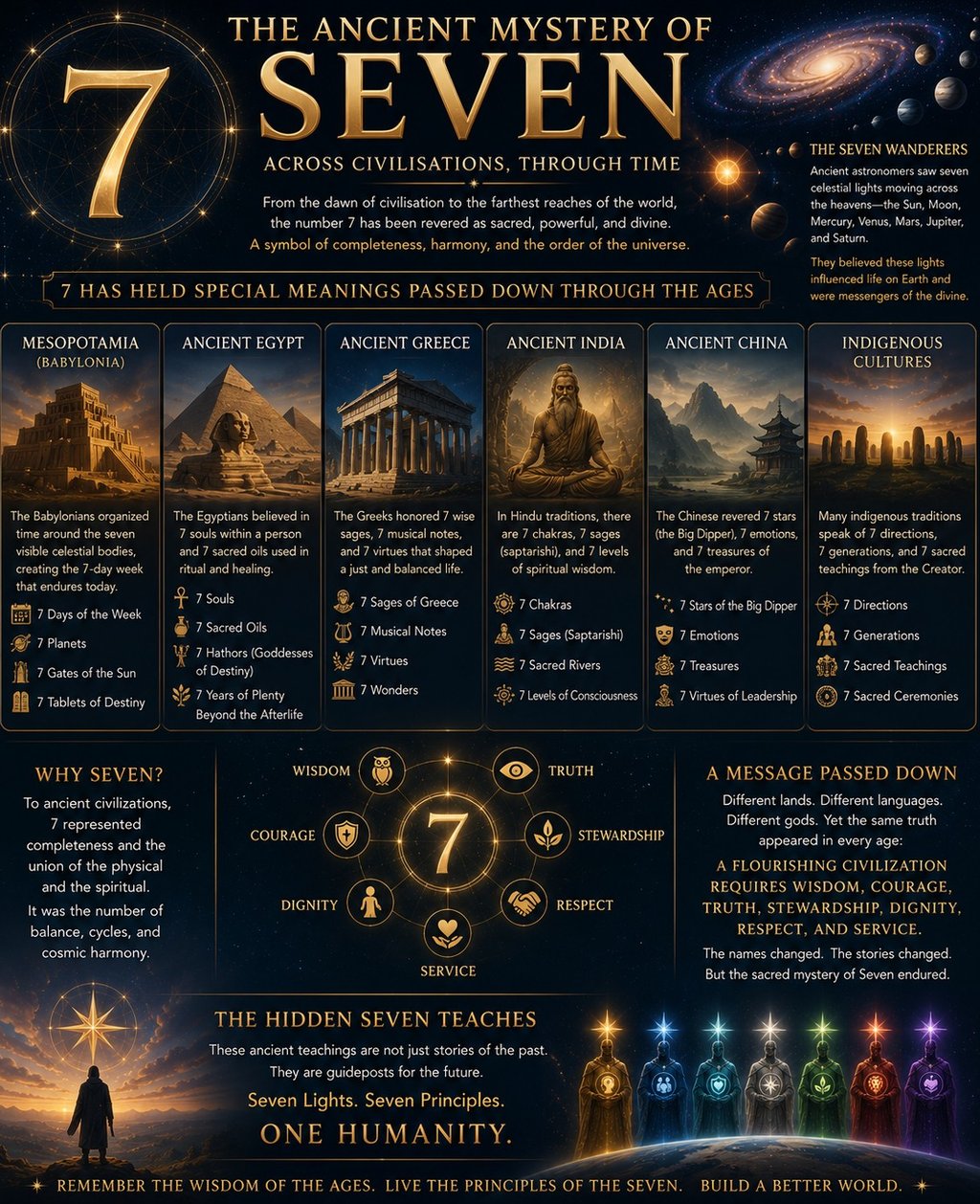
Ancient astronomers observed seven wandering lights moving across the heavens—the Sun, Moon, Mercury, Venus, Mars, Jupiter, and Saturn. Unlike the fixed stars, these celestial bodies followed their own paths through the sky and were often associated with divine powers and heavenly messengers.
The Babylonians organised time around the seven visible celestial bodies, giving rise to the seven-day week that survives to this day.
Many cultures spoke of seven heavens, seven sacred virtues, seven sages, seven gates, seven blessings, or seven stages of spiritual growth.
To the ancients, seven represented completeness.
It was seen as the meeting point between the earthly and the celestial, the material and the spiritual, the individual and the community.
The Hidden Seven teaches that these recurring symbols are echoes of a deeper truth remembered by humanity across the ages.
Whether passed down by gods, ancestors, celestial teachers, or wise elders, the message remained remarkably similar:
A flourishing civilization requires wisdom, courage, truth, stewardship, dignity, respect, and service.
The names changed.
The cultures changed.
The stories changed.
Yet the sacred mystery of Seven endured.
For Guardians, the number seven is not merely a number.
It is a reminder that humanity has always searched for meaning among the stars and that the greatest wisdom is not found in power, but in how we treat one another and the world we share.
Seven Lights.
Seven Principles.
One Humanity.