

Courage Without Hatred: Standing Firm Without Losing Compassion
What Is Courage Without Hatred?
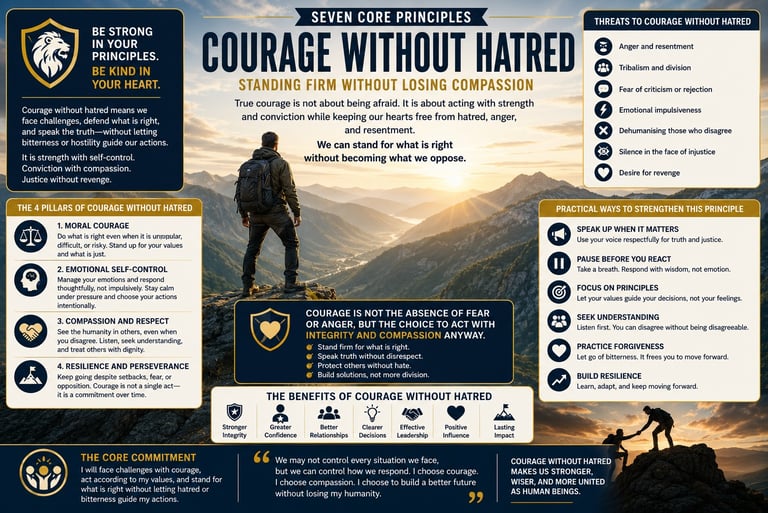
Courage Without Hatred is the principle of standing for what is right, defending truth, protecting others, and facing challenges with strength and conviction—without allowing anger, bitterness, resentment, or hatred to control our actions.
True courage is often misunderstood. Many people associate courage with aggression, confrontation, or dominance. In reality, courage is the ability to act according to your values despite fear, difficulty, uncertainty, or opposition.
Hatred, on the other hand, clouds judgement, fuels division, and often causes people to become what they oppose. Courage without hatred requires strength guided by wisdom, conviction balanced by compassion, and determination rooted in principle rather than hostility.
This principle reminds us that we can oppose harmful actions, challenge injustice, and defend our beliefs without abandoning our humanity.
Why Courage Without Hatred Matters
Life inevitably presents challenges that require courage.
We may face criticism, setbacks, unfair treatment, difficult decisions, or situations that demand us to stand up for ourselves or others. In these moments, it can be tempting to respond with anger, resentment, or hostility.
However, history repeatedly shows that hatred rarely produces lasting solutions. While it may provide temporary emotional satisfaction, it often deepens conflict and prevents understanding.
Throughout my own experiences, I have learned that some of the strongest people are not those who react with aggression but those who remain composed under pressure. They possess the courage to stand firm while maintaining respect, self-control, and integrity.
Courage without hatred helps us to:
Act according to our values.
Remain calm under pressure.
Defend truth and justice responsibly.
Build stronger relationships.
Lead with integrity.
Resolve conflict more effectively.
Maintain personal character during adversity.
Without courage, we may remain silent when action is needed. Without compassion, courage can become destructive.


The Four Pillars of Courage Without Hatred
1. Moral Courage
Moral courage is the willingness to do what is right even when it is unpopular, uncomfortable, or difficult.
This may involve speaking up against wrongdoing, defending someone who is being treated unfairly, admitting mistakes, or standing by your principles despite criticism.
Moral courage involves:
Acting according to your values.
Speaking honestly.
Accepting responsibility.
Defending what is right.
Resisting social pressure.
Doing the right thing is not always easy, but it is often necessary.
2. Emotional Self-Control
Courage is strongest when guided by emotional discipline.
Fear, frustration, and anger are natural human emotions, but they should not dictate our behaviour. Emotional self-control allows us to respond thoughtfully rather than react impulsively.
Emotional self-control includes:
Remaining calm during conflict.
Managing anger constructively.
Pausing before responding.
Thinking clearly under pressure.
Choosing actions intentionally.
Strength without self-control often leads to regret.
3. Compassion and Respect
Courage without hatred recognises the humanity of others, even during disagreement.
Compassion does not require agreement, nor does it mean tolerating harmful behaviour. It means recognising that every individual possesses dignity and worth.
Compassionate courage involves:
Listening respectfully.
Seeking understanding.
Treating opponents with dignity.
Rejecting dehumanisation.
Pursuing solutions rather than revenge.
The goal is not to defeat people but to address problems.
4. Resilience and Perseverance
Courage is not a single act. It is often demonstrated through consistent perseverance.
Life presents obstacles, setbacks, and failures. Courageous individuals continue moving forward despite adversity while remaining committed to their principles.
Resilience includes:
Learning from setbacks.
Adapting to challenges.
Maintaining hope.
Continuing despite fear.
Refusing to be defined by failure.
Perseverance transforms courage into lasting achievement.
Common Threats to Courage Without Hatred
Several attitudes can undermine this principle.
Common threats include:
Fear of criticism.
Fear of failure.
Anger and resentment.
Revenge-seeking behaviour.
Tribalism and division.
Emotional impulsiveness.
Dehumanising those who disagree.
Cynicism and bitterness.
Recognising these threats helps us maintain courage while protecting our character.


Practical Ways to Strengthen Courage Without Hatred
Developing courageous character requires practice and self-awareness.
Speak Up When It Matters
Express your beliefs respectfully when important issues arise.
Manage Emotional Reactions
Pause before responding in moments of frustration or conflict.
Focus on Principles
Anchor your actions in values rather than emotions.
Seek Understanding
Listen to differing perspectives before forming conclusions.
Practice Forgiveness
Refusing to carry bitterness protects your own wellbeing.
Build Resilience
View challenges as opportunities to grow stronger and wiser.
Real-World Example
Imagine a workplace where an employee witnesses unethical behaviour.
One response may be silence out of fear.
Another response may be confrontation driven by anger and hostility.
A person practising courage without hatred takes a different path. They address the issue firmly, report concerns appropriately, remain professional, and focus on resolving the problem rather than attacking individuals.
The courage lies in taking action. The wisdom lies in how the action is taken.
The Benefits of Courage Without Hatred
When this principle becomes part of our character, we develop:
Greater confidence.
Stronger leadership.
Improved emotional resilience.
Better decision-making.
More effective conflict resolution.
Increased trust and credibility.
Stronger personal integrity.
Most importantly, we learn how to face adversity without sacrificing our values.


About the Author
Stephen Mills is the founder of the Seven Core Principles and a lifelong advocate for personal growth, resilience, and principled leadership. Drawing on experiences from business, life challenges, and continuous self-development, he believes that true strength is measured not by power or dominance, but by the ability to remain calm, courageous, and respectful under pressure. Through his writing, Stephen aims to help others build character, overcome adversity, and make a positive impact without compromising their values.
My Experience
Over the years, I have discovered that courage is not measured by how loudly we speak or how aggressively we respond. Some of the most courageous people I have encountered demonstrated remarkable restraint, composure, and integrity during difficult situations.
There have been times when standing firm required uncomfortable conversations, difficult decisions, and the willingness to face criticism. Yet those moments reinforced an important lesson: courage becomes most powerful when it is guided by wisdom, respect, and self-control rather than anger.
True strength is not found in hatred. It is found in the ability to remain principled even when circumstances tempt us to do otherwise.
Core Principle Statement
"I will face challenges with courage, act according to my values, and stand for what is right without allowing hatred, bitterness, or resentment to guide my actions. I will combine strength with compassion, conviction with respect, and perseverance with integrity. Through courage without hatred, I contribute to a stronger, wiser, and more united society."
Courage Without Hatred is the sixth of the Seven Core Principles because character is tested most clearly during adversity. When we learn to act with courage while maintaining compassion and self-control, we develop the strength to overcome challenges without losing our humanity.
Frequently Asked Questions
What is courage without hatred?
Courage Without Hatred is the ability to stand up for what is right, face challenges, and defend your values without allowing anger, bitterness, resentment, or hatred to control your actions. It combines strength with compassion and conviction with respect.
Why is courage important?
Courage is important because it enables us to take action despite fear, uncertainty, or opposition. It helps us make difficult decisions, defend our values, overcome challenges, and pursue meaningful goals even when the path is uncomfortable.
Can you be courageous without being aggressive?
Yes. True courage is not the same as aggression. Courage involves acting with confidence, integrity, and self-control, while aggression is often driven by anger, fear, or the desire to dominate others. Courage seeks solutions; aggression often creates more conflict.
What is moral courage?
Moral courage is the willingness to do what is right even when it is unpopular, difficult, or risky. It includes speaking honestly, standing against injustice, admitting mistakes, and remaining faithful to your values under pressure.
How does hatred weaken courage?
Hatred can cloud judgement, fuel emotional reactions, and lead to decisions driven by resentment rather than wisdom. Courage without hatred allows individuals to remain focused on principles and solutions instead of becoming consumed by anger or revenge.
How can I develop emotional self-control?
Emotional self-control can be strengthened through self-awareness, mindfulness, reflection, patience, and learning to pause before reacting. By managing emotions effectively, individuals are better able to respond thoughtfully during difficult situations.
Can courage and compassion exist together?
Absolutely. In fact, some of the strongest forms of courage are guided by compassion. It takes courage to listen, forgive, seek understanding, and treat others with dignity, especially during conflict or disagreement.
What are the biggest obstacles to courage?
Common obstacles include fear of failure, fear of criticism, self-doubt, social pressure, emotional impulsiveness, and the desire to avoid discomfort. Developing courage involves learning to act despite these challenges.
How does courage improve leadership?
Effective leaders often face difficult decisions, uncertainty, and criticism. Courage helps leaders make principled choices, communicate honestly, take responsibility, and remain committed to their values even during challenging circumstances.
Can courage help resolve conflict?
Yes. Courage allows individuals to address problems directly rather than avoiding them. When combined with respect and emotional control, courage helps create constructive conversations, healthier relationships, and more effective conflict resolution.
How does resilience relate to courage?
Resilience is the ability to recover from setbacks and continue moving forward. Courage often requires resilience because meaningful goals and challenges frequently involve obstacles, failures, and periods of uncertainty.
What is the core message of Courage Without Hatred?
The core message of Courage Without Hatred is that true strength is not measured by aggression or hostility. It is measured by the ability to stand firm in your values, face adversity with integrity, and treat others with dignity even when circumstances are difficult.
References and Further Reading
Frankl, V. E. (2006). Man's Search for Meaning. Beacon Press. (Original work published 1946)
Brown, B. (2018). Dare to Lead: Brave Work. Tough Conversations. Whole Hearts. Random House.
Covey, S. R. (2020). The 7 Habits of Highly Effective People. Simon & Schuster. (Original work published 1989)
Goleman, D. (1995). Emotional Intelligence: Why It Can Matter More Than IQ. Bantam Books.
Sinek, S. (2014). Leaders Eat Last: Why Some Teams Pull Together and Others Don't. Portfolio.
Peck, M. S. (2003). The Road Less Travelled. Simon & Schuster.
King Jr., M. L. (2010). Strength to Love. Beacon Press.
Mandela, N. (1995). Long Walk to Freedom. Little, Brown and Company.
Harvard Business Review. Research on leadership, resilience, emotional intelligence, conflict management, and ethical decision-making.
American Psychological Association (APA). Research on resilience, emotional regulation, courage, and psychological wellbeing.
Disclaimer
The information provided in this article is intended for educational and informational purposes only. The concepts and views expressed are based on personal experience, independent research, observation, and the Seven Core Principles framework developed by Stephen Mills.
While every effort has been made to ensure the accuracy and relevance of the information presented, this content is not intended to replace professional legal, medical, psychological, financial, or other specialist advice. Readers should seek guidance from appropriately qualified professionals where necessary for their individual circumstances.
The Seven Core Principles are designed to encourage personal growth, ethical leadership, responsible decision-making, and positive character development. However, outcomes will vary depending on individual circumstances, commitment, and application.
By engaging with and applying the ideas presented in this article, readers accept responsibility for their own decisions, actions, and results.
Connect
Join our journey toward wisdom and freedom
Subscribe
© 2026. All rights reserved.
The Seven Core Principles framework is intended for personal development and informational purposes and should not be considered legal, medical, financial, or psychological advice.
Use of this website is entirely at your own risk.
About Founder
Contact
Accessibility Statement