
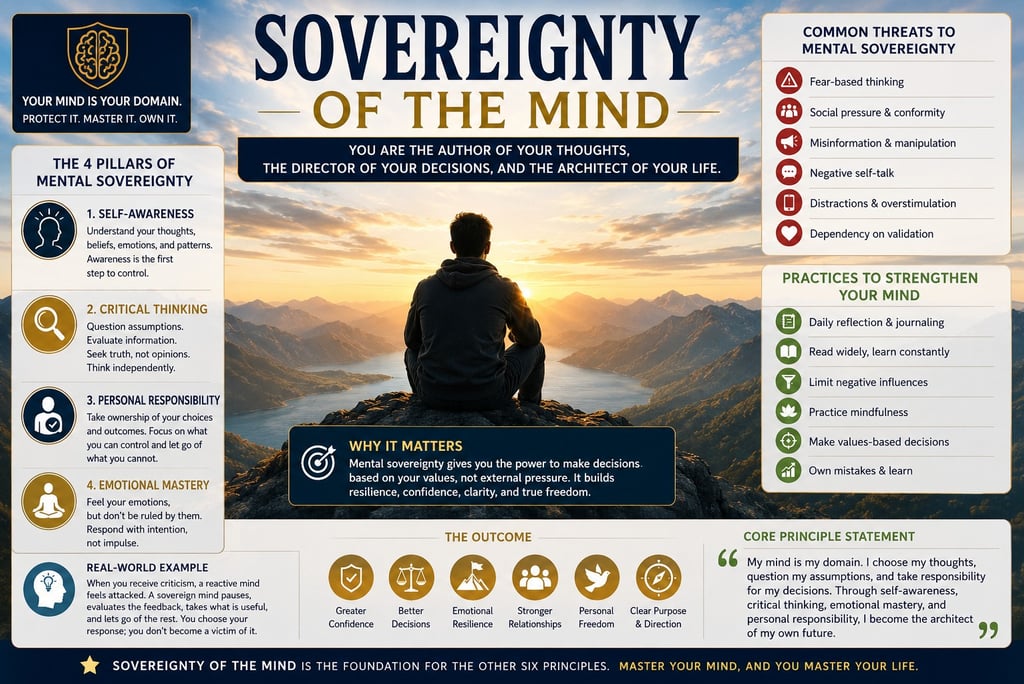

Sovereignty of the Mind: The Foundation of Personal Freedom and Success
What Is Sovereignty of the Mind?
Sovereignty of the Mind is the principle that every individual has the right, responsibility, and ability to govern their own thoughts, beliefs, decisions, and actions. It is the understanding that true freedom begins within and that the quality of our lives is largely determined by the quality of our thinking.
In today's world, we are constantly exposed to external influences—from social media, news outlets, advertising, cultural expectations, and the opinions of others. While these influences can provide valuable information, they should never replace our ability to think independently.
A sovereign mind does not blindly accept information as truth. Instead, it evaluates, questions, and reflects before reaching a conclusion. It understands that personal growth, success, and fulfilment require conscious thought rather than automatic reaction.
This principle serves as the foundation for all other core principles because every decision, action, and outcome begins with a thought.
Why Sovereignty of the Mind Matters
Throughout history, some of the most influential leaders, innovators, and thinkers shared one common trait: they refused to allow others to think for them.
The ability to govern your own mind enables you to:
Make decisions based on your values rather than social pressure.
Develop confidence in your own judgement.
Build resilience during adversity.
Adapt to change without losing direction.
Take ownership of your life and future.
Resist manipulation, misinformation, and fear-based thinking.
Without mental sovereignty, individuals often become reactive rather than intentional, allowing circumstances and external influences to dictate the course of their lives.
The Four Pillars of Mental Sovereignty
1. Self-Awareness
Mental sovereignty begins with self-awareness.
Many people spend years operating on autopilot, rarely questioning why they think, feel, or behave the way they do. Self-awareness requires us to examine our beliefs, motivations, habits, and emotional triggers.
Ask yourself:
Why do I believe what I believe?
Are these beliefs based on evidence or assumption?
Which beliefs support my growth, and which hold me back?
Am I living according to my values or someone else's expectations?
Greater awareness creates greater control.
2. Critical Thinking
Critical thinking is the ability to analyse information objectively before accepting it as truth.
In an age of information overload, this skill has become more important than ever. Sovereign thinkers evaluate evidence, consider multiple perspectives, and remain open to learning while avoiding blind acceptance.
Critical thinking involves:
Questioning assumptions.
Seeking reliable evidence.
Distinguishing facts from opinions.
Recognising bias and emotional manipulation.
Making informed decisions based on reason and understanding.
A sovereign mind is curious, thoughtful, and willing to challenge its own assumptions.
3. Personal Responsibility
One of the clearest signs of mental sovereignty is the willingness to accept responsibility for one's choices.
While we cannot control every circumstance, we can control how we respond to them.
People who embrace personal responsibility understand that blaming others rarely creates progress. Instead, they focus on what they can influence and take action accordingly.
This mindset shifts the question from:
"Why is this happening to me?"
to:
"What can I learn from this, and how will I respond?"
Personal responsibility empowers individuals to become active participants in shaping their future.
4. Emotional Mastery
Mental sovereignty does not mean suppressing emotions. Rather, it means understanding emotions without allowing them to dominate decision-making.
Emotions provide valuable information, but they should not always determine our actions.
Emotionally sovereign individuals:
Recognise their emotional state.
Pause before reacting.
Respond thoughtfully rather than impulsively.
Maintain perspective during difficult situations.
Use emotions as guidance rather than commands.
Emotional mastery creates stability, clarity, and stronger decision-making under pressure.
Common Threats to Mental Sovereignty
Many people unknowingly surrender control of their thinking through external influences and unconscious habits.
Some of the most common threats include:
Fear-based decision-making.
Constant comparison with others.
Social media influence and validation seeking.
Negative self-talk.
Peer pressure.
Misinformation and manipulation.
Limiting beliefs formed through past experiences.
Recognising these influences is the first step towards reclaiming ownership of your mind.


Practical Ways to Strengthen Sovereignty of the Mind
Developing mental sovereignty is an ongoing practice rather than a one-time achievement.
You can strengthen this principle by:
Practice Daily Reflection
Take time each day to examine your thoughts, decisions, and reactions.
Read Widely and Continuously Learn
Expose yourself to different viewpoints and challenge your assumptions.
Limit Negative Influences
Be selective about the information, content, and people you allow to shape your thinking.
Develop Mindfulness
Learn to observe your thoughts without immediately reacting to them.
Make Values-Based Decisions
Act according to your principles rather than temporary emotions or external pressures.
Take Ownership of Mistakes
Every mistake contains a lesson. Accountability accelerates growth.
Real-World Example
Imagine receiving harsh criticism at work.
A person who lacks mental sovereignty may become defensive, angry, or discouraged, allowing the criticism to undermine their confidence.
A person with a sovereign mind takes a different approach. They assess the feedback objectively, separate emotion from fact, identify any valuable lessons, and decide how to respond constructively.
The difference lies not in the criticism itself but in who controls the response.
The Benefits of a Sovereign Mind
When you develop sovereignty of the mind, you gain:
Greater confidence.
Improved decision-making.
Emotional resilience.
Stronger leadership abilities.
Increased personal freedom.
Better relationships.
A clearer sense of purpose and direction.
Most importantly, you become the conscious architect of your life rather than a passive product of circumstance.
Core Principle Statement
"My mind is my domain. I choose my thoughts, question my assumptions, and take responsibility for my decisions. Through self-awareness, critical thinking, emotional mastery, and personal responsibility, I become the architect of my own future."
Sovereignty of the Mind is the first and most fundamental of the Seven Core Principles because every meaningful change begins with how we think. When we master our minds, we create the foundation for growth, leadership, freedom, and lasting success.


About the Author
Stephen Mills keeper of the light is creator of the Seven Core Principles framework, a personal development philosophy focused on self-mastery, purpose, leadership, and personal responsibility. Drawing on years of study in mindset development, business growth, and human behaviour, Stephen helps individuals develop practical strategies for creating meaningful and lasting change.
My Experience
When I first began examining my own thinking patterns, I realised how many decisions were being influenced by fear of failure and the expectations of others. Developing mental sovereignty wasn't about controlling every thought; it was about becoming aware of them and choosing which ones deserved my attention.
Key Takeaways
✓ Mental sovereignty means taking ownership of your thoughts and decisions.
✓ Self-awareness is the foundation of personal growth.
✓ Critical thinking protects against manipulation and misinformation.
✓ Emotional mastery improves decision-making and resilience.
✓ Personal responsibility creates lasting change.
Google often favours content that is easy to scan and understand.
Disclaimer
The information provided in this article is intended for educational and informational purposes only. The concepts and views expressed are based on personal experience, independent research, observation, and the Seven Core Principles framework developed by Stephen Mills.
While every effort has been made to ensure the accuracy and relevance of the information presented, this content is not intended to replace professional legal, medical, psychological, financial, or other specialist advice. Readers should seek guidance from appropriately qualified professionals where necessary for their individual circumstances.
The Seven Core Principles are designed to encourage personal growth, ethical leadership, responsible decision-making, and positive character development. However, outcomes will vary depending on individual circumstances, commitment, and application.
By engaging with and applying the ideas presented in this article, readers accept responsibility for their own decisions, actions, and results.
Frequently Asked Questions
What does Sovereignty of the Mind mean?
Sovereignty of the Mind is the principle that every individual has the right, responsibility, and ability to govern their own thoughts, beliefs, decisions, and actions. It means thinking independently, taking ownership of your mindset, and refusing to allow external influences to control your thinking without conscious consideration.
Why is Sovereignty of the Mind important?
Sovereignty of the Mind is important because every decision, action, and outcome begins with a thought. When individuals take responsibility for their thinking, they are better able to make informed decisions, overcome challenges, develop resilience, and live according to their values rather than external pressures.
How does Sovereignty of the Mind improve personal growth?
Personal growth begins with self-awareness. By examining your beliefs, assumptions, habits, and thought patterns, you gain greater control over your decisions and behaviours. A sovereign mind creates the foundation for continuous learning, self-improvement, and meaningful change.
What is the difference between Sovereignty of the Mind and stubbornness?
A sovereign mind is open to learning, evidence, and new perspectives. Stubbornness often involves refusing to change despite evidence or reason. Sovereignty of the Mind encourages independent thinking while remaining intellectually humble and willing to grow.
How can I develop a sovereign mindset?
You can strengthen mental sovereignty by practising self-awareness, questioning assumptions, developing critical thinking skills, reading widely, reflecting regularly, and taking responsibility for your decisions and actions.
What are the biggest threats to mental sovereignty?
Common threats include fear-based thinking, peer pressure, misinformation, excessive dependence on external validation, negative self-talk, emotional impulsiveness, and blindly accepting the opinions of others without examination.
Does Sovereignty of the Mind mean ignoring other people's opinions?
No. Sovereignty of the Mind does not mean rejecting advice or refusing to listen. It means evaluating information thoughtfully, considering different perspectives, and making decisions based on reason, evidence, and personal values rather than blindly following others.
How does critical thinking support mental sovereignty?
Critical thinking allows individuals to evaluate information objectively, identify bias, question assumptions, and distinguish facts from opinions. It helps people make informed decisions rather than being influenced by misinformation or emotional manipulation.
Can Sovereignty of the Mind improve leadership?
Yes. Effective leaders think independently, remain calm under pressure, make informed decisions, and take responsibility for their actions. Mental sovereignty strengthens confidence, judgement, accountability, and decision-making—qualities essential for leadership.
What role does personal responsibility play in Sovereignty of the Mind?
Personal responsibility is a core component of mental sovereignty. While we cannot control every circumstance, we can control how we respond. Taking responsibility for our thoughts, choices, and actions empowers us to shape our future rather than becoming victims of circumstance.
How does emotional mastery relate to Sovereignty of the Mind?
Emotional mastery allows individuals to recognise and manage emotions without being controlled by them. A sovereign mind acknowledges emotions but does not allow temporary feelings to dictate every decision or action.
What is the core message of Sovereignty of the Mind?
The core message of Sovereignty of the Mind is that true freedom begins with self-governance. By taking ownership of our thoughts, questioning assumptions, developing self-awareness, and acting according to our values, we become the conscious architects of our own lives.
References and Further Reading
Frankl, V. E. (2006). Man's Search for Meaning. Beacon Press. (Original work published 1946)
Dweck, C. S. (2016). Mindset: The New Psychology of Success. Ballantine Books.
Kahneman, D. (2011). Thinking, Fast and Slow. Farrar, Straus and Giroux.
Covey, S. R. (2020). The 7 Habits of Highly Effective People. Simon & Schuster. (Original work published 1989)
Goleman, D. (1995). Emotional Intelligence: Why It Can Matter More Than IQ. Bantam Books.
Brookfield, S. D. (2012). Teaching for Critical Thinking: Tools and Techniques to Help Students Question Their Assumptions. Jossey-Bass.
Clear, J. (2018). Atomic Habits: An Easy & Proven Way to Build Good Habits and Break Bad Ones. Avery.
Seligman, M. E. P. (2011). Flourish: A Visionary New Understanding of Happiness and Well-being. Free Press.
Harvard Business Review. Research on critical thinking, decision-making, leadership, emotional intelligence, and personal effectiveness.
American Psychological Association (APA). Research on cognition, self-awareness, emotional regulation, behavioural psychology, and personal development.
Connect
Join our journey toward wisdom and freedom
Subscribe
© 2026. All rights reserved.
The Seven Core Principles framework is intended for personal development and informational purposes and should not be considered legal, medical, financial, or psychological advice.
Use of this website is entirely at your own risk.
About Founder
Contact
Accessibility Statement