
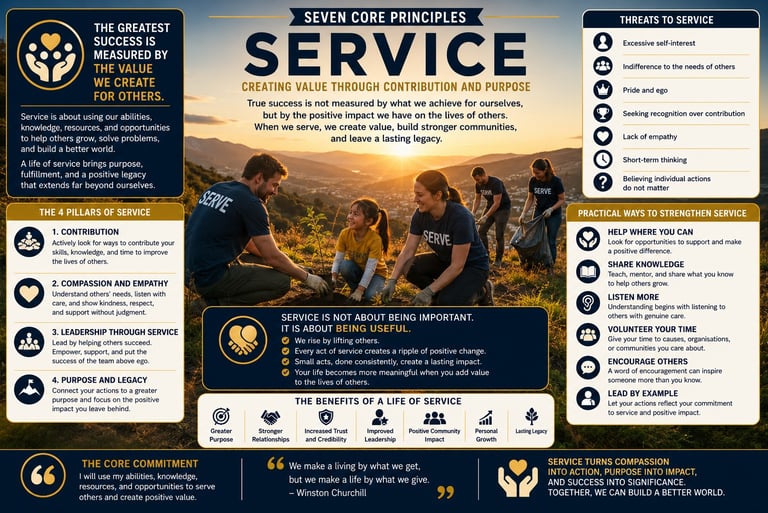

Service: Creating Value Through Contribution and Purpose
What Is Service?
Service is the principle of contributing positively to the lives of others through our actions, skills, knowledge, resources, and character. It is the understanding that meaningful success is not measured solely by what we achieve for ourselves but also by the value we create for others.
Service does not require wealth, status, or authority. Every person has the ability to serve through kindness, leadership, mentorship, support, problem-solving, and everyday acts of contribution.
At its core, service is about recognising that we are part of something larger than ourselves. It encourages us to use our talents and opportunities in ways that benefit individuals, communities, organisations, and future generations.
This principle reminds us that a life focused solely on self-interest often leads to emptiness, while a life focused on contribution creates purpose, fulfilment, and lasting impact.
Why Service Matters
Human progress has always depended upon people serving one another.
Teachers educate students. Healthcare professionals care for patients. Business owners create jobs. Volunteers strengthen communities. Parents nurture children. Leaders guide organisations.
Every thriving society depends on individuals who are willing to contribute beyond their immediate self-interest.
Throughout my own experiences in business and personal development, I have found that the most respected and fulfilled people are often those who focus on helping others succeed. Their influence is not built solely on achievement but on the value they provide to those around them.
Service helps us to:
Build stronger relationships.
Create trust and goodwill.
Develop leadership skills.
Find greater purpose and fulfilment.
Strengthen communities.
Create lasting positive impact.
Leave a meaningful legacy.
Without service, success becomes self-centred and disconnected from the needs of others.
The Four Pillars of Service
1. Contribution
Service begins with the desire to contribute.
Contribution means actively seeking opportunities to improve the lives of others through our actions, knowledge, skills, and effort.
Contribution involves:
Sharing knowledge and experience.
Helping others overcome challenges.
Supporting individuals and communities.
Creating solutions to problems.
Making a positive difference where possible.
Every contribution, no matter how small, has the potential to create meaningful impact.
2. Compassion and Empathy
Effective service requires understanding the needs of others.
Compassion enables us to recognise when people need support, encouragement, guidance, or assistance. Empathy helps us understand different experiences and perspectives.
Compassionate service includes:
Listening actively.
Understanding challenges.
Showing kindness and respect.
Offering support without judgement.
Treating people with dignity.
People are more likely to trust those who genuinely care about their wellbeing.
3. Leadership Through Service
True leadership is rooted in service.
The most effective leaders understand that leadership is not about power or personal recognition. It is about helping others succeed, creating opportunities, and serving a greater purpose.
Service-based leadership involves:
Supporting team members.
Empowering others.
Sharing credit.
Taking responsibility.
Putting collective success above personal ego.
Leaders who serve often inspire greater trust, loyalty, and performance.
4. Purpose and Legacy
Service connects daily actions to a larger purpose.
People often discover deeper fulfilment when they focus on making a positive difference rather than pursuing personal gain alone.
Purpose-driven service includes:
Aligning actions with values.
Contributing to meaningful causes.
Investing in future generations.
Building something that outlasts personal success.
Leaving a positive legacy.
A meaningful life is often measured by the impact we have on others.


Common Threats to Service
Several attitudes can weaken a commitment to service.
Common threats include:
Excessive self-interest.
Indifference to the needs of others.
Pride and ego.
Seeking recognition over contribution.
Lack of empathy.
Short-term thinking.
A belief that individual actions do not matter.
Recognising these obstacles helps us maintain a service-oriented mindset.
Practical Ways to Strengthen Service
Service is developed through consistent daily actions.
Help Where You Can
Look for opportunities to support others, even through small acts of kindness.
Share Knowledge
Use your experience and expertise to help others learn and grow.
Listen More
Understanding someone's needs often begins with listening.
Volunteer Your Time
Contribute to causes, organisations, or communities that align with your values.
Encourage Others
A simple word of encouragement can have a lasting impact.
Lead Through Example
Demonstrate service through your actions rather than relying solely on words.
Real-World Example
Imagine two business owners.
One focuses entirely on personal profit and views customers merely as transactions.
The other focuses on solving problems, providing genuine value, supporting employees, and serving customers with integrity.
While both may achieve financial success, the second is more likely to build trust, loyalty, positive relationships, and long-term sustainability.
The difference lies in a commitment to service.
The Benefits of Service
When service becomes a core principle, individuals experience:
Greater purpose and fulfilment.
Stronger relationships.
Increased trust and credibility.
Improved leadership skills.
Greater community impact.
Enhanced personal growth.
A meaningful and lasting legacy.
Most importantly, service transforms success from something we achieve into something we share.


About the Author
Stephen Mills is the creator of the Seven Core Principles, a character-based framework designed to help individuals build stronger foundations for personal growth, leadership, and meaningful success. Through years of business experience, self-development, and a passion for understanding human potential, Stephen has come to believe that the most fulfilling achievements are those that positively impact the lives of others. His work focuses on encouraging people to lead with integrity, contribute with purpose, and create lasting value in their families, communities, and professions.
My Experience
One lesson that has become increasingly clear throughout my journey is that the most rewarding achievements are often those that benefit others as well as ourselves.
Some of the most meaningful opportunities, relationships, and successes I have experienced were not the result of focusing solely on personal gain but of seeking ways to contribute, support, and create value for others. In many cases, the greatest rewards emerged as a by-product of service rather than the primary goal.
Service has reinforced the belief that influence is earned through contribution and that a meaningful life is built not only on what we accomplish but on the positive difference we make.
Frequently Asked Questions
What is service?
Service is the act of contributing positively to the lives of others through our actions, skills, knowledge, resources, and character. It involves creating value, helping others grow, and making a meaningful difference in our communities, workplaces, and relationships.
Why is service important?
Service is important because it strengthens relationships, builds trust, supports communities, and creates a sense of purpose. By focusing on contribution rather than self-interest alone, individuals can create lasting positive impact and experience greater personal fulfilment.
Does service require money or wealth?
No. Service is not limited to financial contributions. People can serve others through kindness, encouragement, volunteering, mentoring, teaching, listening, sharing knowledge, and helping solve problems. Every person has the ability to serve regardless of their financial circumstances.
How does service improve personal growth?
Service encourages empathy, leadership, communication, and self-awareness. By focusing on the needs of others, individuals often develop stronger character, greater emotional intelligence, and a deeper sense of purpose.
What is servant leadership?
Servant leadership is a leadership approach that prioritises serving others rather than seeking power or personal recognition. Servant leaders focus on helping people succeed, supporting growth, and creating environments where individuals and teams can thrive.
Can service improve leadership skills?
Yes. Effective leadership often begins with service. Leaders who focus on helping others, building trust, and creating value are more likely to inspire loyalty, collaboration, and long-term success.
What are some practical ways to serve others?
Service can be demonstrated by volunteering, mentoring, supporting local communities, helping colleagues, sharing knowledge, listening to others, offering encouragement, and using personal skills to solve problems or create opportunities.
What are the benefits of living a life of service?
A life of service can lead to stronger relationships, greater trust, increased fulfilment, improved leadership abilities, personal growth, and a lasting positive impact on others. Many people discover their greatest sense of purpose through contribution.
Can small acts of service make a difference?
Absolutely. Small acts of kindness, support, and encouragement often have a greater impact than we realise. Consistent acts of service can strengthen relationships, improve wellbeing, and create positive ripple effects throughout communities.
How does service contribute to a meaningful life?
Many people find that lasting fulfilment comes not from what they accumulate but from the value they create for others. Service connects individuals to a larger purpose and helps transform personal success into positive impact.
What are the biggest obstacles to service?
Common obstacles include excessive self-interest, lack of empathy, pride, seeking recognition rather than contribution, and believing that individual actions do not matter. Overcoming these barriers allows people to focus on making a meaningful difference.
What is the core message of Service?
The core message of Service is that true fulfilment comes from contribution. By using our abilities, resources, and opportunities to help others, we create value, strengthen communities, and leave a positive legacy that extends beyond our own success.
Core Principle Statement
"I will use my abilities, knowledge, resources, and opportunities to serve others and create positive value. I will lead with compassion, contribute with purpose, and seek to leave people, communities, and organisations better than I found them. Through service, I help build a stronger, more connected, and more compassionate world."
Service is the seventh and final of the Seven Core Principles because it brings all the other principles together. When we govern our minds, respect others, honour dignity, seek truth, practise stewardship, and demonstrate courage, we become better equipped to serve. Service transforms personal growth into positive impact and turns individual success into collective benefit.
References and Further Reading
Greenleaf, R. K. (2002). Servant Leadership: A Journey into the Nature of Legitimate Power and Greatness. Paulist Press.
Sinek, S. (2014). Leaders Eat Last: Why Some Teams Pull Together and Others Don't. Portfolio.
Covey, S. R. (2020). The 7 Habits of Highly Effective People. Simon & Schuster. (Original work published 1989)
Frankl, V. E. (2006). Man's Search for Meaning. Beacon Press. (Original work published 1946)
Brown, B. (2018). Dare to Lead: Brave Work. Tough Conversations. Whole Hearts. Random House.
Drucker, P. F. (2006). The Effective Executive: The Definitive Guide to Getting the Right Things Done. Harper Business.
Brooks, A. C. (2023). Build the Life You Want: The Art and Science of Getting Happier. Portfolio.
Carnegie, D. (2020). How to Win Friends and Influence People. Simon & Schuster. (Original work published 1936)
Harvard Business Review. Research on servant leadership, employee engagement, trust, organisational culture, and purpose-driven leadership.
The Greater Good Science Center, University of California, Berkeley. Research on compassion, altruism, empathy, gratitude, and wellbeing.
United Nations. Sustainable Development Goals (SDGs): Creating positive social impact through collective responsibility and contribution.
Disclaimer
The information provided in this article is intended for educational and informational purposes only. The concepts and views expressed are based on personal experience, independent research, observation, and the Seven Core Principles framework developed by Stephen Mills.
While every effort has been made to ensure the accuracy and relevance of the information presented, this content is not intended to replace professional legal, medical, psychological, financial, or other specialist advice. Readers should seek guidance from appropriately qualified professionals where necessary for their individual circumstances.
The Seven Core Principles are designed to encourage personal growth, ethical leadership, responsible decision-making, and positive character development. However, outcomes will vary depending on individual circumstances, commitment, and application.
By engaging with and applying the ideas presented in this article, readers accept responsibility for their own decisions, actions, and results.
"Success becomes meaningful when it creates value beyond ourselves. Service transforms personal achievement into positive impact and lasting contribution."
Connect
Join our journey toward wisdom and freedom
Subscribe
© 2026. All rights reserved.
The Seven Core Principles framework is intended for personal development and informational purposes and should not be considered legal, medical, financial, or psychological advice.
Use of this website is entirely at your own risk.
About Founder
Contact
Accessibility Statement