

Respect for All People: The Foundation of Strong Relationships and Meaningful Leadership
What Is Respect for All People?
Respect for All People is the principle that every individual possesses inherent worth and dignity regardless of their background, beliefs, status, achievements, culture, ethnicity, religion, gender, age, or personal circumstances.
Respect does not require agreement. It does not mean accepting harmful behaviour or abandoning personal values. Rather, it means recognising the humanity in others and treating people with fairness, courtesy, empathy, and consideration.
In an increasingly divided world, genuine respect has become one of the most powerful qualities a person can develop. It strengthens relationships, promotes understanding, reduces conflict, and creates environments where individuals can grow and thrive.
This principle reminds us that how we treat others is a direct reflection of our character.
Why Respect for All People Matters
Throughout my own personal and professional experiences, I have observed that the most respected leaders are rarely those with the most authority. Instead, they are often the individuals who consistently treat others with dignity, regardless of position or circumstance.
True respect builds trust.
Whether in business, family life, friendships, or community relationships, people are far more likely to listen, cooperate, and contribute when they feel valued and respected.
Respect for others enables us to:
Build stronger relationships.
Develop trust and credibility.
Improve communication.
Reduce unnecessary conflict.
Create inclusive and supportive environments.
Lead with integrity and influence.
Foster personal and professional growth.
Without respect, even the strongest relationships eventually become strained.


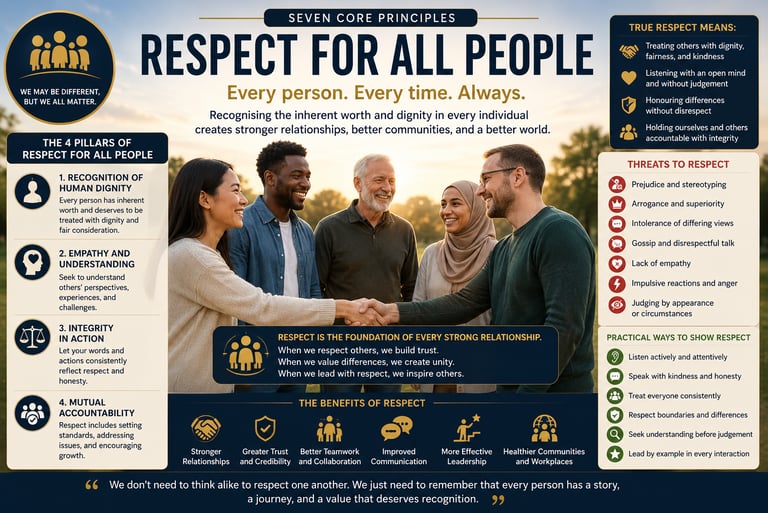
The Four Pillars of Respect for All People
1. Recognition of Human Dignity
Every person has intrinsic value.
Regardless of social status, occupation, education, wealth, or background, each individual deserves to be treated with basic dignity and consideration.
Recognising human dignity means:
Treating others fairly.
Listening without prejudice.
Avoiding discrimination.
Valuing people for who they are rather than what they can provide.
Respect begins when we acknowledge that every person matters.
2. Empathy and Understanding
Respect grows when we seek to understand the experiences, perspectives, and challenges of others.
Empathy does not require us to agree with another person's opinions or choices. It simply requires us to appreciate that their experiences may differ from our own.
Practising empathy involves:
Listening actively.
Asking thoughtful questions.
Avoiding assumptions.
Considering different perspectives.
When people feel understood, meaningful connections become possible.
3. Integrity in Action
Respect is demonstrated through behaviour, not merely words.
Many people claim to respect others while acting in ways that undermine trust and dignity. Genuine respect requires consistency between values and actions.
Integrity-based respect includes:
Keeping commitments.
Speaking honestly.
Treating people fairly.
Taking responsibility for mistakes.
Showing courtesy even during disagreement.
How we behave when challenged often reveals the true depth of our respect for others.
4. Mutual Accountability
Respect is not weakness. It includes holding ourselves and others accountable for actions and behaviour.
A respectful society, workplace, or relationship requires standards.
Mutual accountability means:
Addressing issues constructively.
Setting healthy boundaries.
Challenging harmful behaviour appropriately.
Encouraging growth and responsibility.
True respect seeks what is best for others, even when difficult conversations are necessary.
Common Threats to Respect
Respect can be undermined by attitudes and behaviours that create division and conflict.
Common threats include:
Prejudice and stereotyping.
Arrogance and superiority.
Intolerance of differing views.
Gossip and disrespectful communication.
Lack of empathy.
Impulsive reactions driven by anger.
Judging people solely by appearances or circumstances.
Recognising these behaviours allows us to consciously choose a more respectful approach.
Practical Ways to Strengthen Respect for Others
Developing respect is a lifelong practice that requires awareness and intentional effort.
Listen More Than You Speak
Give people the opportunity to express themselves fully before responding.
Seek Understanding Before Judgement
Ask questions and learn about different perspectives.
Treat Everyone Consistently
Show the same courtesy to a stranger as you would to a friend, colleague, or customer.
Communicate with Kindness
Words have power. Choose language that builds understanding rather than division.
Respect Boundaries
Recognise and honour the personal limits and needs of others.
Lead by Example
Demonstrate respect through your actions, especially during disagreements or challenging situations.
Real-World Example
Imagine a workplace where an employee disagrees with a manager's decision.
A culture lacking respect may dismiss the employee's concerns, leading to frustration and disengagement.
A culture built on respect encourages open discussion. The employee is heard, the manager explains their reasoning, and both parties leave with greater understanding, even if the final decision remains unchanged.
Respect does not eliminate disagreement; it creates a framework for handling disagreement constructively.
The Benefits of Respect for All People
When respect becomes a core principle, individuals and communities experience:
Stronger relationships.
Increased trust.
Better teamwork.
Improved communication.
Greater emotional intelligence.
More effective leadership.
Healthier communities and workplaces.
Most importantly, respect creates environments where people feel valued, heard, and empowered to contribute.


About the Author
Stephen Mills is the creator of the Seven Core Principles, a personal development framework designed to help individuals build character, strengthen relationships, develop leadership skills, and live with greater purpose and integrity. Drawing on years of study, research, business experience, and personal growth, Stephen shares practical insights that empower people to take responsibility for their lives and achieve meaningful, lasting success. His work focuses on self-mastery, personal accountability, respect, resilience, and the values that contribute to a thriving society.
Key Takeaways
Respect for All People begins with recognising the inherent worth and dignity of every individual.
Respect does not require agreement; it requires fairness, empathy, and consideration.
Strong relationships, effective leadership, and healthy communities are built on mutual respect.
Empathy helps us understand different perspectives without compromising our own values.
Integrity and accountability are essential components of genuine respect.
Respectful communication reduces conflict and strengthens trust.
Every interaction provides an opportunity to demonstrate respect through words, actions, and attitude.
By practising respect consistently, we create stronger relationships, foster greater understanding, and contribute to a more positive and compassionate society.
Frequently Asked Questions
What does respect for all people mean?
Respect for All People means recognising that every individual possesses inherent worth and dignity regardless of their background, beliefs, status, culture, ethnicity, religion, age, or personal circumstances. It involves treating others with fairness, courtesy, empathy, and consideration.
Why is respect important?
Respect is essential because it builds trust, improves communication, strengthens relationships, and creates environments where people feel valued and understood. Without respect, cooperation and meaningful relationships become difficult to maintain.
Does respecting someone mean agreeing with them?
No. Respect does not require agreement. It is possible to disagree with someone's opinions, beliefs, or decisions while still treating them with dignity and courtesy. Respect focuses on how we treat people, not whether we share their views.
How can I show respect in everyday life?
You can demonstrate respect by listening actively, communicating honestly, being considerate of others' feelings, respecting boundaries, keeping commitments, and treating everyone with fairness regardless of their position or circumstances.
What are the benefits of showing respect?
Respect contributes to stronger relationships, greater trust, improved teamwork, better communication, increased emotional intelligence, and more effective leadership. It also helps create healthier families, workplaces, and communities.
Can respect improve leadership?
Absolutely. The most effective leaders understand that influence is built on trust and credibility. Leaders who consistently demonstrate respect inspire loyalty, encourage collaboration, and create environments where people feel empowered to contribute their best work.
Research and Expert Perspectives
Many respected researchers and thought leaders have highlighted the importance of respect, empathy, and human dignity in personal and professional success.
Psychologist and emotional intelligence pioneer Daniel Goleman emphasises that empathy is a critical leadership skill, enabling individuals to build stronger relationships and understand the needs of others more effectively.
Leadership researcher Brené Brown's work consistently demonstrates that vulnerability, empathy, and genuine human connection are essential for building trust and creating healthy cultures.
The principles of respect and dignity are also reflected in the work of Viktor Frankl, who observed that every person possesses inherent value and the capacity to choose how they respond to life's circumstances.
Research in organisational psychology has repeatedly shown that workplaces built on respect experience higher employee engagement, stronger collaboration, greater innovation, and improved overall performance.
These findings reinforce a simple truth: respect is not merely a social courtesy—it is a fundamental ingredient of personal growth, effective leadership, and thriving communities.
Author's Reflection
As I developed the Seven Core Principles framework, I became increasingly aware that many of life's conflicts arise not from our differences but from how we respond to those differences.
Some of the most valuable relationships, opportunities, and lessons in my life have come from people whose experiences, beliefs, or perspectives differed greatly from my own. By approaching those interactions with curiosity and respect rather than judgement, I gained insights that broadened my understanding and challenged my assumptions.
Respect for All People is not about abandoning your principles. It is about recognising that every individual has a story, a perspective, and a value that deserves acknowledgement. When we lead with respect, we create the conditions for trust, understanding, and meaningful human connection.
References and Further Reading
Brown, B. (2018). Dare to Lead: Brave Work. Tough Conversations. Whole Hearts. Random House.
Frankl, V. E. (2006). Man's Search for Meaning. Beacon Press. (Original work published 1946)
Goleman, D. (1995). Emotional Intelligence: Why It Can Matter More Than IQ. Bantam Books.
Goleman, D. (2006). Social Intelligence: The New Science of Human Relationships. Bantam Books.
Covey, S. R. (2020). The 7 Habits of Highly Effective People. Simon & Schuster.
Carnegie, D. (2020). How to Win Friends and Influence People. Simon & Schuster. (Original work published 1936)
The Universal Declaration of Human Rights. (1948). United Nations.
Disclaimer
The information provided in this article is intended for educational and informational purposes only. The concepts and views expressed are based on personal experience, independent research, observation, and the Seven Core Principles framework developed by Stephen Mills.
While every effort has been made to ensure the accuracy and relevance of the information presented, this content is not intended to replace professional legal, medical, psychological, financial, or other specialist advice. Readers should seek guidance from appropriately qualified professionals where necessary for their individual circumstances.
The Seven Core Principles are designed to encourage personal growth, ethical leadership, responsible decision-making, and positive character development. However, outcomes will vary depending on individual circumstances, commitment, and application.
By engaging with and applying the ideas presented in this article, readers accept responsibility for their own decisions, actions, and results.
Connect
Join our journey toward wisdom and freedom
Subscribe
© 2026. All rights reserved.
The Seven Core Principles framework is intended for personal development and informational purposes and should not be considered legal, medical, financial, or psychological advice.
Use of this website is entirely at your own risk.
About Founder
Contact
Accessibility Statement