
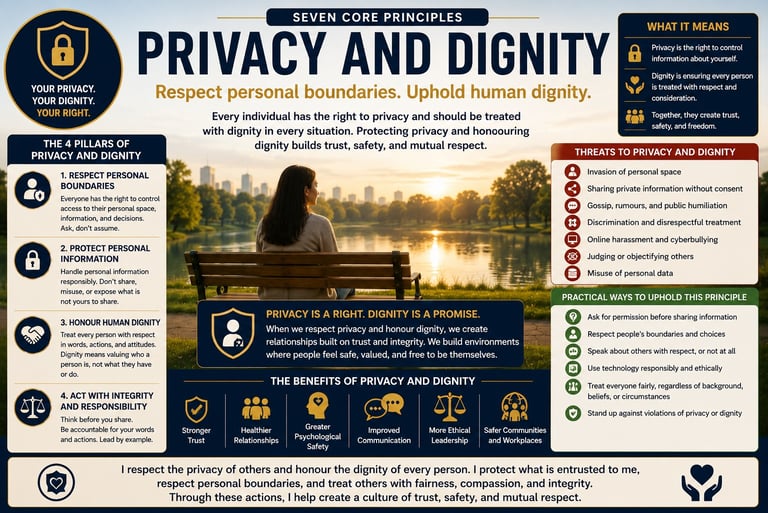

Privacy and Dignity: Protecting What Makes Us Human
What Is Privacy and Dignity?
Privacy and Dignity is the principle that every person has the right to personal boundaries, respect, and control over their own information, choices, and identity. It recognises that human dignity is not earned through status, wealth, achievements, or social position—it is an inherent quality possessed by every individual.
Privacy protects our personal space, thoughts, information, and autonomy. Dignity ensures that we are treated with respect, fairness, and consideration as human beings.
Together, privacy and dignity form the foundation of trust, safety, freedom, and healthy relationships. When these principles are respected, individuals feel secure, valued, and empowered. When they are violated, trust is damaged, relationships suffer, and people can experience emotional, social, and psychological harm.
This principle reminds us that how we treat the privacy and dignity of others reflects our own character and integrity.
Why Privacy and Dignity Matter
In today's interconnected world, privacy and dignity are more important than ever. Technology allows information to travel instantly, opinions to spread widely, and personal details to be shared without consent.
At the same time, many people face situations where their dignity is challenged through discrimination, public humiliation, gossip, online abuse, or disrespectful treatment.
Throughout my own experiences in business and everyday life, I have found that trust flourishes when people feel safe. People are more willing to collaborate, communicate openly, and contribute positively when they know their privacy will be respected and their dignity protected.
Privacy and dignity help us to:
Build trust and credibility.
Strengthen relationships.
Promote emotional wellbeing.
Encourage honest communication.
Create safer communities and workplaces.
Support individual freedom and autonomy.
Foster mutual respect and understanding.
Without privacy and dignity, trust becomes fragile and relationships become vulnerable.
The Four Pillars of Privacy and Dignity
1. Respect Personal Boundaries
Every person has the right to establish boundaries regarding their personal space, time, information, and decisions.
Respecting boundaries means recognising that not everything belongs in the public domain and not every question requires an answer.
This includes:
Respecting personal space.
Accepting reasonable limits.
Seeking consent before sharing information.
Avoiding intrusive behaviour.
Honouring an individual's right to say no.
Healthy boundaries create healthier relationships.
2. Protect Personal Information
Trust requires responsible handling of information.
Whether online, at work, within families, or among friends, we have a responsibility to protect information that has been shared in confidence.
Protecting personal information means:
Not sharing private details without permission.
Using technology responsibly.
Safeguarding confidential information.
Respecting digital privacy.
Being mindful of how information is stored and communicated.
What is entrusted to us should never be used carelessly.
3. Honour Human Dignity
Dignity means recognising the inherent worth of every person regardless of their background, beliefs, circumstances, appearance, or achievements.
A person's value is not determined by what they own, where they come from, or what they can offer us.
Honouring dignity involves:
Treating people with courtesy and respect.
Avoiding humiliation or ridicule.
Rejecting discrimination and prejudice.
Speaking about others with integrity.
Recognising the humanity in every individual.
Respecting dignity is one of the clearest expressions of character.
4. Act with Integrity and Responsibility
Privacy and dignity are protected through ethical behaviour.
It is not enough to understand these values; we must consistently apply them in our actions and decisions.
Responsible conduct includes:
Thinking before sharing information.
Being accountable for our words.
Using technology ethically.
Challenging behaviour that undermines dignity.
Leading by example.
Integrity transforms principles into practice.
Common Threats to Privacy and Dignity
Many modern challenges can undermine privacy and dignity if left unchecked.
These include:
Sharing personal information without consent.
Gossip and rumour spreading.
Public shaming and humiliation.
Online harassment and cyberbullying.
Discrimination and prejudice.
Invasive behaviour.
Misuse of personal data.
Judging individuals solely by appearance, status, or circumstances.
Recognising these threats helps us make more conscious and ethical choices.


Practical Ways to Uphold Privacy and Dignity
Developing respect for privacy and dignity requires daily awareness and intentional action.
Ask Before Sharing
Always obtain permission before sharing personal information, photographs, conversations, or experiences involving others.
Respect Personal Boundaries
Accept that people have different comfort levels regarding privacy, communication, and personal matters.
Speak About Others with Integrity
Avoid gossip, rumours, and conversations that diminish another person's dignity.
Use Technology Responsibly
Be mindful of what you post, share, record, or distribute online.
Treat Every Person with Respect
Recognise that dignity belongs to everyone, regardless of differences in background, beliefs, or circumstances.
Lead by Example
Demonstrate the behaviour you wish to see in others by consistently respecting privacy and protecting dignity.
Real-World Example
Imagine a colleague confides in you about a personal challenge they are facing.
A person who disregards privacy may share that information with others, believing it is harmless conversation. The result is damaged trust and potential embarrassment.
A person who values privacy and dignity treats the information with care and confidentiality. By doing so, they strengthen trust and demonstrate integrity.
The difference lies not in the information itself but in how it is handled.
The Benefits of Privacy and Dignity
When privacy and dignity are respected, individuals and communities benefit from:
Stronger trust.
Healthier relationships.
Greater psychological safety.
Improved communication.
Increased confidence and self-respect.
More ethical leadership.
Safer workplaces and communities.
Most importantly, people feel valued, respected, and secure.


About the Author
Stephen Mills is the creator of the Seven Core Principles, a personal development framework designed to help individuals build character, strengthen relationships, develop leadership skills, and live with greater purpose and integrity. Drawing on years of study, research, business experience, and personal growth, Stephen shares practical insights that empower people to take responsibility for their lives and achieve meaningful, lasting success. His work focuses on self-mastery, personal accountability, respect, resilience, and the values that contribute to a thriving society.
My Experience
Throughout my life, I have observed that trust is one of the most valuable assets a person can possess. Trust is not built through grand gestures but through consistent respect for people's boundaries, confidence, and dignity.
Some of the strongest relationships I have developed—both personally and professionally—have been built on the simple understanding that what is shared in confidence remains protected and that every person deserves to be treated with respect regardless of their circumstances.
Privacy and dignity are not merely social niceties. They are essential foundations of trust, character, and meaningful human connection.
Core Principle Statement
"I respect the privacy of others and honour the dignity of every person. I protect what is entrusted to me, respect personal boundaries, and treat others with fairness, compassion, and integrity. Through these actions, I help create a culture of trust, safety, and mutual respect."
Privacy and Dignity is the third of the Seven Core Principles because trust cannot exist without respect for personal boundaries, and healthy relationships cannot flourish without recognising the inherent worth of every individual.
References and Further Reading
Brown, B. (2018). Dare to Lead: Brave Work. Tough Conversations. Whole Hearts. Random House.
Covey, S. R. (2020). The 7 Habits of Highly Effective People. Simon & Schuster. (Original work published 1989)
Frankl, V. E. (2006). Man's Search for Meaning. Beacon Press. (Original work published 1946)
Goleman, D. (1995). Emotional Intelligence: Why It Can Matter More Than IQ. Bantam Books.
Nussbaum, M. C. (2011). Creating Capabilities: The Human Development Approach. Harvard University Press.
Floridi, L. (2014). The Fourth Revolution: How the Infosphere is Reshaping Human Reality. Oxford University Press.
United Nations. (1948). Universal Declaration of Human Rights.
United Nations. (1966). International Covenant on Civil and Political Rights.
Harvard Business Review. Research on workplace trust, psychological safety, ethical leadership, and organisational culture.
The Information Commissioner's Office (ICO). Guidance on privacy, data protection, and responsible information handling.
World Health Organization (WHO). Research on dignity, human rights, wellbeing, and social inclusion.
Disclaimer
The information provided in this article is intended for educational and informational purposes only. The concepts and views expressed are based on personal experience, independent research, observation, and the Seven Core Principles framework developed by Stephen Mills.
While every effort has been made to ensure the accuracy and relevance of the information presented, this content is not intended to replace professional legal, medical, psychological, financial, or other specialist advice. Readers should seek guidance from appropriately qualified professionals where necessary for their individual circumstances.
The Seven Core Principles are designed to encourage personal growth, ethical leadership, responsible decision-making, and positive character development. However, outcomes will vary depending on individual circumstances, commitment, and application.
By engaging with and applying the ideas presented in this article, readers accept responsibility for their own decisions, actions, and results.
Connect
Join our journey toward wisdom and freedom
Subscribe
© 2026. All rights reserved.
The Seven Core Principles framework is intended for personal development and informational purposes and should not be considered legal, medical, financial, or psychological advice.
Use of this website is entirely at your own risk.
About Founder
Contact
Accessibility Statement