
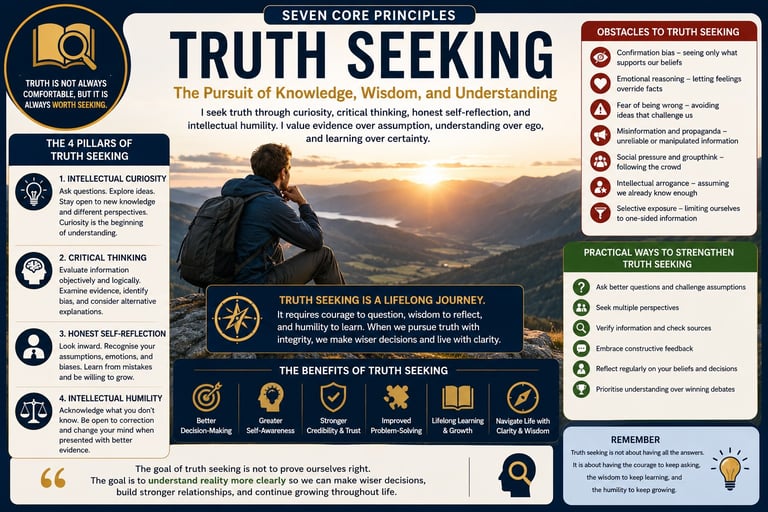

Truth Seeking: The Pursuit of Knowledge, Wisdom, and Understanding
What Is Truth Seeking?
Truth Seeking is the principle of actively pursuing knowledge, understanding, and objective reality through curiosity, critical thinking, evidence, and honest self-reflection. It is the commitment to seek what is true rather than simply accepting what is comfortable, popular, or convenient.
Truth seeking requires intellectual humility—the willingness to recognise that our beliefs, assumptions, and opinions may be incomplete or incorrect. It challenges us to remain open-minded while maintaining a commitment to evidence, reason, and honest inquiry.
In a world filled with misinformation, bias, and competing narratives, truth seeking has become one of the most valuable skills an individual can develop. It enables better decision-making, stronger relationships, greater wisdom, and a deeper understanding of ourselves and the world around us.
This principle reminds us that growth begins when we are willing to pursue truth, even when it challenges our existing beliefs.
Why Truth Seeking Matters
Every decision we make is influenced by what we believe to be true.
When our understanding is accurate, our decisions are more likely to produce positive outcomes. When our understanding is distorted by assumptions, misinformation, bias, or wishful thinking, we risk making poor choices that affect ourselves and others.
Throughout my own journey of personal development and business growth, I have discovered that progress often begins with asking difficult questions. Some of the most important lessons I have learned came from challenging my assumptions, admitting mistakes, and being willing to change my perspective when presented with better evidence.
Truth seeking helps us to:
Make better decisions.
Develop critical thinking skills.
Avoid manipulation and misinformation.
Improve self-awareness.
Build credibility and trust.
Foster personal growth.
Navigate complexity with greater confidence.
Without a commitment to truth, growth becomes limited by illusion and misunderstanding.


The Four Pillars of Truth Seeking
1. Intellectual Curiosity
Truth seekers are driven by curiosity.
Rather than accepting information at face value, they ask questions, seek understanding, and explore different perspectives. Curiosity encourages lifelong learning and prevents intellectual stagnation.
Intellectual curiosity involves:
Asking thoughtful questions.
Exploring unfamiliar ideas.
Seeking knowledge from reliable sources.
Remaining open to learning.
Embracing continuous growth.
Curiosity is often the first step toward discovering deeper truths.
2. Critical Thinking
Critical thinking is the ability to evaluate information objectively and logically.
Truth seekers examine evidence, assess sources, and recognise the difference between facts, opinions, assumptions, and emotions.
Critical thinking includes:
Evaluating evidence.
Identifying bias.
Questioning assumptions.
Considering alternative explanations.
Making reasoned conclusions.
The goal is not to be sceptical of everything but to be thoughtful about what we accept as true.
3. Honest Self-Reflection
Seeking truth requires looking inward as well as outward.
Many of our greatest blind spots exist within our own thinking. Honest self-reflection allows us to identify personal biases, emotional influences, and limiting beliefs that may distort our perception of reality.
Self-reflection involves:
Examining personal assumptions.
Accepting responsibility for mistakes.
Recognising emotional influences.
Learning from experience.
Remaining open to feedback.
Growth becomes possible when we are willing to confront uncomfortable truths about ourselves.
4. Intellectual Humility
Truth seekers understand that knowledge is always evolving.
Intellectual humility is the willingness to admit uncertainty, change one's mind when presented with compelling evidence, and acknowledge the limits of personal knowledge.
This includes:
Being open to correction.
Listening to differing viewpoints.
Avoiding arrogance and dogmatism.
Valuing evidence over ego.
Prioritising understanding over being right.
True wisdom often begins with recognising how much we still have to learn.


Common Obstacles to Truth Seeking
Several factors can prevent us from seeing reality clearly.
Common obstacles include:
Confirmation bias.
Emotional reasoning.
Fear of being wrong.
Social pressure and groupthink.
Misinformation and propaganda.
Intellectual arrogance.
Selective exposure to information.
Unquestioned assumptions.
Awareness of these obstacles helps us pursue truth more effectively.
Practical Ways to Strengthen Truth Seeking
Truth seeking is a lifelong practice that requires discipline and curiosity.
Ask Better Questions
Instead of asking, "How can I prove I'm right?" ask, "What evidence supports or challenges this belief?"
Seek Multiple Perspectives
Explore different viewpoints before forming conclusions.
Verify Information
Check facts, evaluate sources, and avoid relying solely on headlines or social media content.
Embrace Constructive Feedback
View feedback as an opportunity to learn rather than a personal attack.
Reflect Regularly
Take time to examine your assumptions, decisions, and beliefs.
Prioritise Understanding Over Winning
Focus on discovering what is true rather than simply defending a position.
Real-World Example
Imagine reading an article that strongly supports a viewpoint you already hold.
A person who is not committed to truth seeking may immediately accept the information because it confirms their existing beliefs.
A truth seeker takes a different approach. They examine the source, consider alternative viewpoints, evaluate supporting evidence, and remain open to changing their position if the facts lead elsewhere.
The difference lies not in intelligence but in the willingness to pursue truth over confirmation.
The Benefits of Truth Seeking
When truth seeking becomes a core principle, individuals gain:
Better decision-making.
Increased wisdom.
Greater self-awareness.
Improved problem-solving abilities.
Stronger credibility and trust.
Enhanced adaptability.
Lifelong learning and personal growth.
Most importantly, truth seeking enables us to navigate life with greater clarity, understanding, and integrit


About the Author
Stephen Mills is the creator of the Seven Core Principles, a personal development framework designed to help individuals build character, strengthen relationships, develop leadership skills, and live with greater purpose and integrity. Drawing on years of study, research, business experience, and personal growth, Stephen shares practical insights that empower people to take responsibility for their lives and achieve meaningful, lasting success. His work focuses on self-mastery, personal accountability, respect, resilience, and the values that contribute to a thriving society.
My Experience
One of the most valuable lessons I have learned is that personal growth often begins when we stop defending our assumptions and start questioning them.
There have been times when evidence challenged beliefs I held strongly. While those moments were uncomfortable, they often led to greater understanding and better decisions. The willingness to learn, adapt, and change course when necessary has been essential to both personal and professional development.
Truth seeking is not about always being right. It is about remaining committed to learning, understanding, and pursuing reality as honestly as possible.
Frequently Asked Questions
What is truth seeking?
Truth seeking is the ongoing process of pursuing knowledge, understanding, and objective reality through curiosity, critical thinking, evidence, and honest self-reflection. It involves a willingness to question assumptions, evaluate information carefully, and remain open to learning.
Why is truth seeking important?
Truth seeking is important because our decisions are based on what we believe to be true. The more accurately we understand ourselves, others, and the world around us, the better equipped we are to make wise decisions, solve problems, and achieve meaningful growth.
What is the difference between truth seeking and being right?
Truth seeking focuses on discovering what is true, while being right often focuses on defending a position or opinion. A truth seeker values learning and understanding, even when new evidence requires them to change their mind.
How does truth seeking improve decision-making?
Truth seeking improves decision-making by encouraging individuals to gather evidence, consider multiple perspectives, and avoid assumptions. This leads to more informed choices and reduces the likelihood of being influenced by misinformation or bias.
What are the biggest obstacles to truth seeking?
Common obstacles include confirmation bias, emotional reasoning, fear of being wrong, social pressure, misinformation, intellectual arrogance, and the tendency to seek information that only supports existing beliefs.
Can truth seeking strengthen relationships?
Yes. Truth seeking promotes honesty, understanding, and open communication. It encourages people to listen, ask questions, and seek clarity rather than making assumptions, which can strengthen trust and improve relationships.
How can I become a better truth seeker?
You can become a better truth seeker by asking thoughtful questions, evaluating evidence carefully, seeking diverse perspectives, embracing feedback, reflecting on your beliefs, and remaining willing to learn from new information.
Does truth seeking mean questioning everything?
Not necessarily. Truth seeking means thinking critically and evaluating information rather than accepting it blindly. It encourages healthy curiosity and informed judgement rather than constant scepticism.
What role does intellectual humility play in truth seeking?
Intellectual humility allows us to recognise that our knowledge is limited and that we may sometimes be wrong. This mindset helps us stay open to learning, accept correction, and continue growing throughout life.
How does truth seeking contribute to personal growth?
Personal growth depends on our ability to recognise reality accurately. Truth seeking helps individuals identify strengths, weaknesses, opportunities, and challenges more clearly, creating a stronger foundation for self-improvement and lifelong learning.
Can truth seeking help in leadership?
Absolutely. Effective leaders make better decisions when they are committed to facts, evidence, and honest feedback. Truth-seeking leaders foster trust, encourage open dialogue, and create environments where learning and improvement can flourish.
What is the core message of Truth Seeking?
The core message of Truth Seeking is that wisdom begins with curiosity, grows through critical thinking, and matures through humility. By pursuing truth with honesty and integrity, we develop a clearer understanding of ourselves, others, and the world around us.
Core Principle Statement
"I seek truth through curiosity, critical thinking, honest self-reflection, and intellectual humility. I value evidence over assumption, understanding over ego, and learning over certainty. By pursuing truth with integrity, I make wiser decisions and contribute to a more informed and responsible society."
Truth Seeking is the fourth of the Seven Core Principles because every meaningful decision depends upon our understanding of reality. The closer we move toward truth, the greater our capacity for wisdom, growth, and positive impact.
Disclaimer
The information provided in this article is intended for educational and informational purposes only. The concepts and views expressed are based on personal experience, independent research, observation, and the Seven Core Principles framework developed by Stephen Mills.
While every effort has been made to ensure the accuracy and relevance of the information presented, this content is not intended to replace professional legal, medical, psychological, financial, or other specialist advice. Readers should seek guidance from appropriately qualified professionals where necessary for their individual circumstances.
The Seven Core Principles are designed to encourage personal growth, ethical leadership, responsible decision-making, and positive character development. However, outcomes will vary depending on individual circumstances, commitment, and application.
By engaging with and applying the ideas presented in this article, readers accept responsibility for their own decisions, actions, and results.
References and Further Reading
Kahneman, D. (2011). Thinking, Fast and Slow. Farrar, Straus and Giroux.
Dweck, C. S. (2016). Mindset: The New Psychology of Success. Ballantine Books.
Frankl, V. E. (2006). Man's Search for Meaning. Beacon Press. (Original work published 1946)
Covey, S. R. (2020). The 7 Habits of Highly Effective People. Simon & Schuster. (Original work published 1989)
Popper, K. (2002). The Logic of Scientific Discovery. Routledge. (Original work published 1934)
Sagan, C. (1997). The Demon-Haunted World: Science as a Candle in the Dark. Ballantine Books.
Tetlock, P. E., & Gardner, D. (2016). Superforecasting: The Art and Science of Prediction. Crown Publishing.
Brookfield, S. D. (2012). Teaching for Critical Thinking: Tools and Techniques to Help Students Question Their Assumptions. Jossey-Bass.
Harvard Business Review. Research on critical thinking, decision-making, cognitive bias, leadership, and organisational learning.
American Psychological Association (APA). Research on cognitive bias, reasoning, learning, and behavioural psychology.
The Royal Society. Publications on scientific inquiry, evidence-based thinking, and intellectual integrity.
"The goal of truth seeking is not to prove ourselves right. The goal is to understand reality more clearly so we can make wiser decisions, build stronger relationships, and continue growing throughout life."
Connect
Join our journey toward wisdom and freedom
Subscribe
© 2026. All rights reserved.
The Seven Core Principles framework is intended for personal development and informational purposes and should not be considered legal, medical, financial, or psychological advice.
Use of this website is entirely at your own risk.
About Founder
Contact
Accessibility Statement