
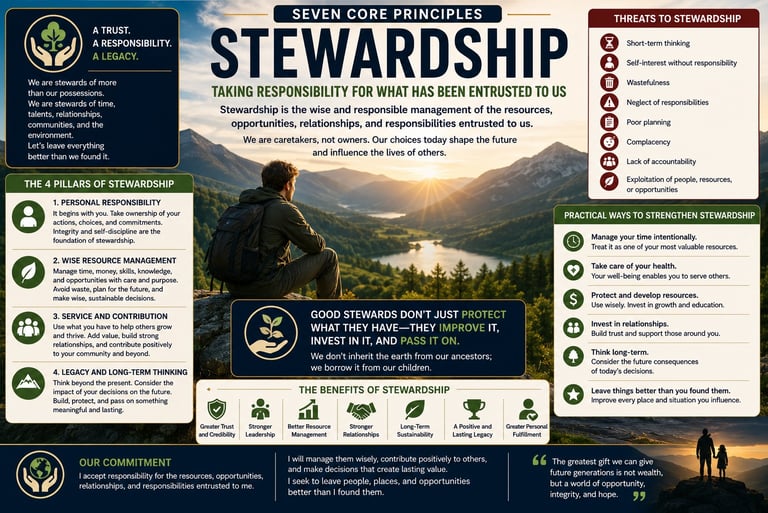

Stewardship: Taking Responsibility for What Has Been Entrusted to Us
What Is Stewardship?
Stewardship is the principle of responsibly managing, protecting, and improving the resources, opportunities, relationships, and responsibilities entrusted to us. It is the understanding that we are caretakers rather than owners and that our actions today influence the wellbeing of future generations.
Stewardship extends beyond financial resources. It includes how we manage our time, talents, knowledge, health, relationships, communities, businesses, and the environment. A steward recognises that every resource carries responsibility and that true success is measured not only by what we gain but by what we preserve, improve, and pass on to others.
In a world often focused on short-term rewards, stewardship encourages long-term thinking, accountability, and service. It reminds us that our choices have consequences and that we have a responsibility to leave people, places, and systems better than we found them.
Why Stewardship Matters
Every individual has been entrusted with resources, opportunities, and influence, regardless of their position in life.
Some people are entrusted with businesses, others with families, communities, careers, knowledge, or leadership responsibilities. Regardless of the form these responsibilities take, how we manage them shapes both our own future and the future of those around us.
Throughout my personal and professional experiences, I have observed that sustainable success is rarely achieved through consumption alone. The individuals and organisations that create lasting impact are often those who think beyond themselves and focus on preserving, improving, and contributing.
Stewardship helps us to:
Build trust and credibility.
Develop long-term thinking.
Create lasting value.
Strengthen relationships and communities.
Improve leadership effectiveness.
Encourage responsibility and accountability.
Leave a positive legacy.
Without stewardship, resources are often wasted, opportunities are lost, and future generations inherit unnecessary challenges.


The Four Pillars of Stewardship
1. Personal Responsibility
Stewardship begins with taking ownership of our actions, choices, and obligations.
Before we can responsibly manage larger responsibilities, we must first manage ourselves effectively. This includes our habits, commitments, behaviour, and decision-making.
Personal responsibility involves:
Honouring commitments.
Managing time wisely.
Taking accountability for outcomes.
Maintaining self-discipline.
Acting with integrity.
Effective stewardship starts with self-leadership.
2. Wise Resource Management
Every resource should be managed with care and purpose.
Resources include money, time, energy, knowledge, skills, relationships, and opportunities. Stewardship requires using these resources efficiently and responsibly rather than wasting or neglecting them.
Wise resource management includes:
Planning for the future.
Avoiding unnecessary waste.
Investing in growth and development.
Protecting valuable assets.
Making sustainable decisions.
Good stewards understand that resources are finite and valuable.
3. Service and Contribution
Stewardship is not solely about preservation; it is also about contribution.
A steward seeks to create value for others and improve the lives of those they influence. They understand that success becomes more meaningful when it benefits others as well as themselves.
Service and contribution involve:
Helping others grow.
Sharing knowledge and experience.
Supporting communities.
Mentoring and developing future leaders.
Creating opportunities for others.
Contribution transforms stewardship into positive impact.
4. Legacy and Long-Term Thinking
Stewards think beyond immediate results.
They consider how today's decisions will affect future outcomes and future generations. Long-term thinking encourages sustainable choices and discourages short-term decisions that create long-term problems.
Legacy-focused stewardship includes:
Preserving what is valuable.
Building for the future.
Considering long-term consequences.
Protecting future opportunities.
Creating lasting positive influence.
The best stewards leave things better than they found them.
Common Threats to Stewardship
Several attitudes and behaviours can undermine responsible stewardship.
Common threats include:
Short-term thinking.
Self-interest without responsibility.
Wastefulness.
Neglect of responsibilities.
Poor planning.
Complacency.
Lack of accountability.
Exploitation of people, resources, or opportunities.
Recognising these threats allows us to make more intentional and responsible choices.


Practical Ways to Strengthen Stewardship
Stewardship is developed through consistent daily habits and decisions.
Manage Your Time Intentionally
Treat time as one of your most valuable resources and use it wisely.
Take Care of Your Health
Your physical and mental wellbeing influence your ability to serve others and fulfil your responsibilities.
Protect and Develop Resources
Manage finances, knowledge, skills, and opportunities responsibly.
Invest in Relationships
Build trust, support others, and contribute positively to the people around you.
Think Long-Term
Consider the future consequences of today's decisions.
Leave Things Better Than You Found Them
Whether at home, work, or in your community, seek to improve rather than merely consume.
Real-World Example
Imagine two business owners who inherit similar opportunities.
One focuses solely on short-term profits, neglects staff development, ignores long-term planning, and extracts as much value as possible.
The other invests in employees, serves customers well, plans for future growth, and builds systems that create long-term sustainability.
While both may experience success initially, the second approach is far more likely to create lasting impact, trust, and value.
The difference lies in stewardship.
The Benefits of Stewardship
When stewardship becomes a core principle, individuals and organisations experience:
Greater trust and credibility.
Improved leadership.
Stronger relationships.
Better resource management.
Long-term sustainability.
Increased personal fulfilment.
A positive and lasting legacy.
Most importantly, stewardship encourages us to move beyond self-interest and contribute to something greater than ourselves.


About the Author
Stephen Mills is the founder of the Seven Core Principles and a lifelong student of personal growth, leadership, and human potential. His experiences in business and life have reinforced the belief that success is not measured solely by what we achieve, but by how responsibly we manage what has been entrusted to us and the positive impact we leave behind. Through his writing, Stephen encourages others to live with purpose, integrity, and a commitment to leaving things better than they found them.
My Experience
Over the years, I have come to realise that many of life's greatest opportunities arrive disguised as responsibilities. Whether managing a business, supporting a family, mentoring others, or contributing to a community, success often depends on how well we care for what has been entrusted to us.
Some of the most respected people I have encountered were not necessarily the wealthiest or most accomplished. They were individuals who consistently acted with responsibility, integrity, and a genuine desire to leave things better than they found them.
Stewardship is not simply about management; it is about responsibility, service, and creating value that endures.
Frequently Asked Questions
What is stewardship?
Stewardship is the responsible management and care of the resources, opportunities, relationships, and responsibilities entrusted to us. It involves using what we have wisely, acting with accountability, and creating value for both present and future generations.
Why is stewardship important?
Stewardship is important because our decisions affect not only our own lives but also the lives of others. Responsible stewardship helps preserve resources, strengthen relationships, build trust, and create sustainable success over the long term.
What does stewardship mean in everyday life?
In everyday life, stewardship means managing your time wisely, caring for your health, being responsible with finances, maintaining strong relationships, fulfilling commitments, and contributing positively to your community and environment.
How is stewardship connected to leadership?
Effective leadership requires stewardship. Great leaders understand that leadership is not about power or control but about responsibility. They seek to serve others, develop people, protect resources, and leave organisations stronger than they found them.
What are the key qualities of a good steward?
A good steward demonstrates responsibility, integrity, accountability, discipline, long-term thinking, and a commitment to serving others. They understand that every resource and opportunity carries both privilege and responsibility.
Is stewardship only about money?
No. While financial responsibility is one aspect of stewardship, the principle extends far beyond money. Stewardship also includes managing time, talents, knowledge, relationships, health, opportunities, and influence in a responsible and purposeful way.
How can I become a better steward?
You can become a better steward by taking responsibility for your actions, managing resources carefully, planning for the future, honouring commitments, investing in personal growth, and seeking ways to contribute positively to others.
What are the biggest threats to stewardship?
Common threats include short-term thinking, wastefulness, neglect of responsibilities, poor planning, self-interest without accountability, and failing to consider the long-term consequences of decisions.
How does stewardship benefit future generations?
Stewardship encourages us to think beyond our immediate needs and consider the impact of our choices on those who come after us. By managing resources responsibly and building sustainable systems, we help create opportunities and stability for future generations.
What is the relationship between stewardship and legacy?
Stewardship and legacy are closely connected. The way we manage our responsibilities, resources, and relationships today shapes the legacy we leave behind. A positive legacy is often the result of consistent stewardship over time.
Can stewardship improve personal success?
Yes. Stewardship promotes discipline, responsibility, planning, and wise decision-making. These qualities contribute to stronger relationships, better leadership, financial stability, personal growth, and long-term success.
What is the core message of stewardship?
The core message of stewardship is that we are responsible for what has been entrusted to us. By managing resources wisely, serving others, and thinking beyond ourselves, we create lasting value and leave people, places, and opportunities better than we found them.
Core Principle Statement
"I accept responsibility for the resources, opportunities, relationships, and responsibilities entrusted to me. I will manage them wisely, contribute positively to others, and make decisions that create lasting value. Through stewardship, I seek to leave people, places, and opportunities better than I found them."
Stewardship is the fifth of the Seven Core Principles because sustainable success requires more than achievement. It requires responsibility. By managing what we have been entrusted with wisely and ethically, we create value not only for ourselves but for future generations as well.
References and Further Reading
Covey, S. R. (2020). The 7 Habits of Highly Effective People. Simon & Schuster. (Original work published 1989)
Drucker, P. F. (2006). The Effective Executive: The Definitive Guide to Getting the Right Things Done. Harper Business.
Collins, J. (2001). Good to Great: Why Some Companies Make the Leap... and Others Don't. Harper Business.
Greenleaf, R. K. (2002). Servant Leadership: A Journey into the Nature of Legitimate Power and Greatness. Paulist Press.
Sinek, S. (2014). Leaders Eat Last: Why Some Teams Pull Together and Others Don't. Portfolio.
Frankl, V. E. (2006). Man's Search for Meaning. Beacon Press. (Original work published 1946)
De Pree, M. (2004). Leadership Is an Art. Crown Business.
The United Nations Sustainable Development Goals (SDGs). United Nations.
Harvard Business Review. Research on leadership, accountability, organisational culture, long-term value creation, and sustainable business practices.
World Economic Forum. Research on responsible leadership, sustainability, and stakeholder responsibility.
"Stewardship is not measured by what we possess, but by how responsibly we manage what has been entrusted to us and the value we leave behind for others."
Disclaimer
The information provided in this article is intended for educational and informational purposes only. The concepts and views expressed are based on personal experience, independent research, observation, and the Seven Core Principles framework developed by Stephen Mills.
While every effort has been made to ensure the accuracy and relevance of the information presented, this content is not intended to replace professional legal, medical, psychological, financial, or other specialist advice. Readers should seek guidance from appropriately qualified professionals where necessary for their individual circumstances.
The Seven Core Principles are designed to encourage personal growth, ethical leadership, responsible decision-making, and positive character development. However, outcomes will vary depending on individual circumstances, commitment, and application.
By engaging with and applying the ideas presented in this article, readers accept responsibility for their own decisions, actions, and results.
Connect
Join our journey toward wisdom and freedom
Subscribe
© 2026. All rights reserved.
The Seven Core Principles framework is intended for personal development and informational purposes and should not be considered legal, medical, financial, or psychological advice.
Use of this website is entirely at your own risk.
About Founder
Contact
Accessibility Statement