
Truth Over Outrage: How to Avoid Social Media Conflict and Become a Better Truth Seeker
Learn why social media algorithms reward conflict and misinformation, and discover practical ways to seek truth, avoid online arguments, and build respectful conversations as a Guardian.
TRUTH SEEKING
keeper of the Light
7/17/20264 min read
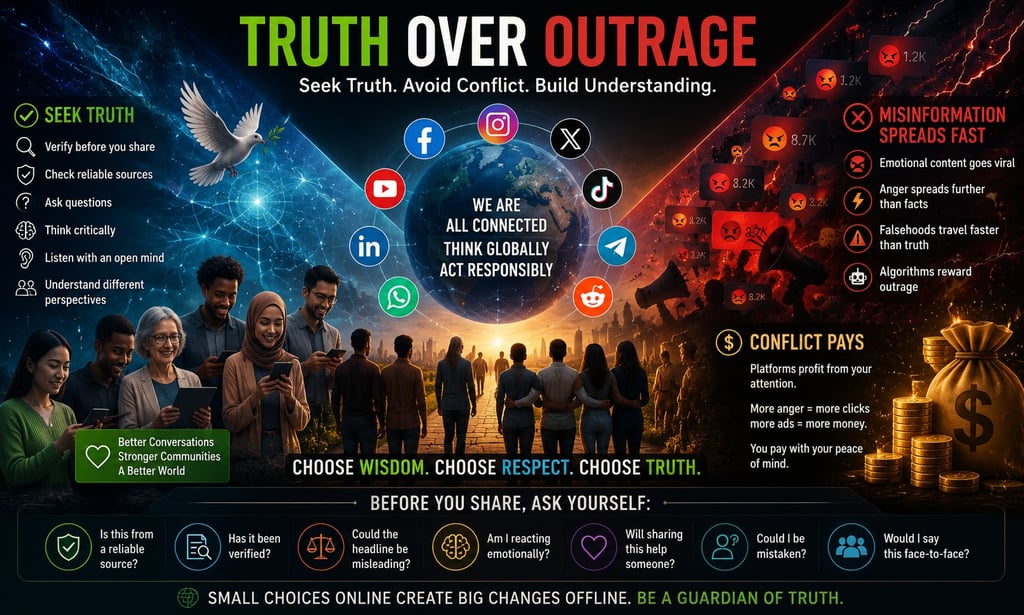
Truth Over Outrage: Why Guardians Choose Wisdom Instead of Social Media Conflict
In a world where every opinion can become an argument, choosing truth is becoming an act of courage.
Every day, billions of people scroll through social media looking for news, entertainment, connection, or simply a few moments of distraction.
What many people don't realise is that these platforms are not designed primarily to help us discover the truth.
They are designed to keep our attention.
The longer we stay, the more advertisements we see. The more advertisements we see, the more revenue the platform generates.
That business model has shaped how social media works—and it has changed how information spreads.
Why Conflict Travels Faster Than Facts
Research in psychology, communication, and computer science has consistently found that emotionally charged content receives more engagement than calm, balanced discussion.
When people feel angry, shocked, fearful, or morally outraged, they are more likely to:
Comment
Share
React
Quote posts
Stay engaged for longer
These interactions signal to recommendation algorithms that a post is "interesting."
As a result, the content is often shown to even more people.
This creates a cycle where outrage can spread much faster than careful analysis.
The algorithm is not choosing sides.
It is responding to behaviour.
If millions of people engage with conflict, conflict becomes more visible.
Misinformation Spreads Easily
False or misleading information often has advantages over accurate reporting.
It may be:
More surprising
More emotionally powerful
Easier to understand
Better suited to dramatic headlines
Shared before experts have time to verify the facts
By the time corrections appear, the original story may already have reached millions of people.
This is one reason why learning to pause before sharing information is so important.
Truth usually takes time.
Rumours travel at the speed of emotion.
The Hidden Cost of Online Arguments
Many online discussions begin with good intentions.
Someone wants to explain.
Someone else wants to disagree.
Before long, the conversation becomes personal.
People stop listening.
Positions become more extreme.
Friendships suffer.
Stress increases.
Very few minds are changed.
Psychologists describe this as identity-protective thinking. Once people feel their identity, values, or group is under attack, they often defend their position more strongly—even when presented with evidence.
Winning the argument becomes more important than finding the truth.
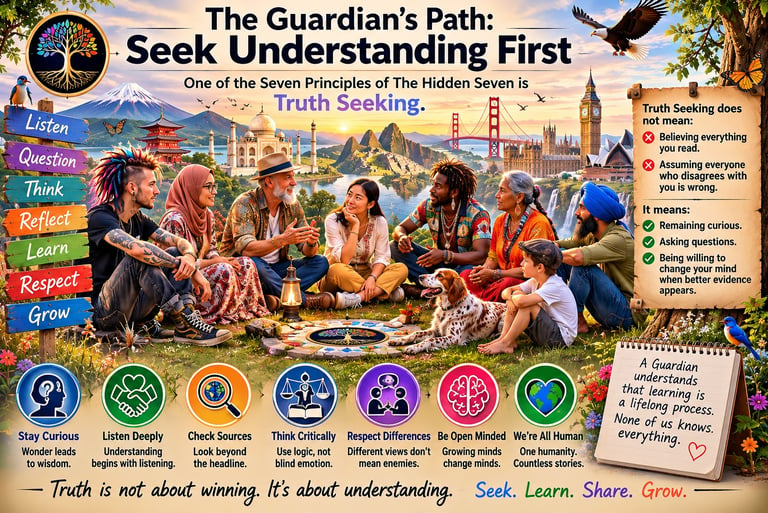
The Guardian's Path: Seek Understanding First
One of the Seven Principles of The Hidden Seven is Truth Seeking.
Truth Seeking does not mean believing everything you read.
Nor does it mean assuming everyone who disagrees with you is wrong.
It means remaining curious.
It means asking questions.
It means being willing to change your mind when better evidence appears.
A Guardian understands that learning is a lifelong process.
None of us knows everything.
Before You Share, Ask Seven Questions
Before reposting an article or joining a heated discussion, pause and ask yourself:
Is this information from a reliable source?
Has it been independently verified?
Could the headline be misleading?
Am I reacting emotionally rather than rationally?
Will sharing this genuinely help someone?
Could I be mistaken?
Would I say these words face-to-face?
These simple questions can prevent countless misunderstandings.
Not Every Battle Needs Fighting
It is perfectly acceptable to walk away from an argument.
Silence is not weakness.
Sometimes it is wisdom.
Some people are not looking for discussion.
They are looking for attention.
Others are determined to win rather than learn.
Your time and emotional energy are valuable resources.
Protect them.
Choose conversations where people genuinely want to exchange ideas.
Build Bridges Instead of Walls
Healthy communities are built through respectful disagreement.
You can disagree without insulting.
Challenge ideas without attacking people.
Ask questions before making assumptions.
Listen as carefully as you speak.
Many disagreements disappear once people realise they misunderstood one another.
Respect creates opportunities for learning.
Contempt closes them.
What the Evidence Shows
Studies have found that social media algorithms tend to amplify content that generates strong emotional engagement, including anger and moral outrage, because these reactions increase clicks, comments, shares, and time spent on the platform. Researchers have also shown that false or misleading information can spread faster than accurate information because it is often more novel and emotionally engaging. This does not mean platforms intentionally promote falsehoods, but it does mean their engagement-driven design can unintentionally reward sensational and divisive content.
Understanding this helps us become more thoughtful users rather than passive participants.
Carry the Light
The world does not need more shouting.
It needs more listening.
It does not need more outrage.
It needs more understanding.
Every time you verify a claim before sharing it...
Every time you refuse to insult someone who disagrees with you...
Every time you choose curiosity over certainty...
You make the online world a little healthier.
Truth is rarely found in the loudest voice.
It is found by those willing to question, to learn, and to follow the evidence wherever it leads.
That is the path of a Guardian.
Choose truth.
Choose respect.
And wherever possible, leave every conversation better than you found it.


Connect
Join our journey toward wisdom and freedom
Subscribe
© 2026. All rights reserved.
The Seven Core Principles framework is intended for personal development and informational purposes and should not be considered legal, medical, financial, or psychological advice.
Use of this website is entirely at your own risk.
About Founder
Contact
Accessibility Statement