PART III
Building Strong Communities
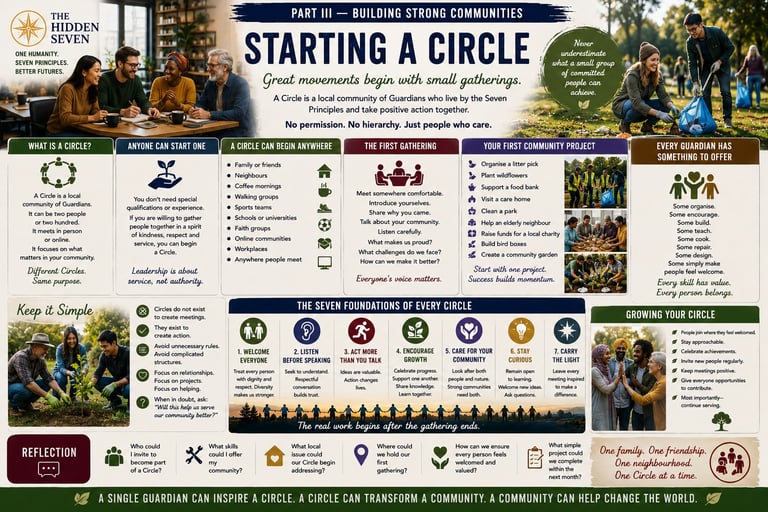
Starting a Circle
Great Movements Begin with Small Gatherings
Every community begins with people.
Not buildings.
Not organisations.
Not funding.
Just people who decide to care about one another and work together.
History is full of examples of ordinary people gathering around shared values to improve the places where they live.
The Hidden Seven calls these groups Circles.
A Circle is simply a small group of people who choose to live by the Seven Principles and take positive action together.
It does not need a building.
It does not need formal membership.
It does not need permission.
It only needs people willing to Carry the Light.
What Is a Circle?
A Circle is a local community of Guardians.
Some Circles may have only two members.
Others may grow into dozens or even hundreds.
Every Circle is unique because every community has different needs.
Some meet every week.
Others meet once a month.
Some focus on environmental projects.
Others help vulnerable people.
Some simply meet for coffee, conversation and encouragement before taking action together.
There is no perfect size.
There is no perfect format.
The purpose remains the same:
Support one another. Serve your community. Live the Seven Principles.
Anyone Can Start One
You do not need special qualifications.
You do not need leadership experience.
You do not need permission from The Hidden Seven.
If you are willing to gather people together in a spirit of kindness, respect and service, you can begin a Circle.
Leadership is not about authority.
It is about creating opportunities for others to contribute.


A Circle Can Begin Anywhere
Some of the strongest communities begin in the most ordinary places.
A Circle could begin with:
A family around the dinner table.
Two neighbours chatting over the garden fence.
Friends meeting in a local café.
A weekly coffee morning.
A book club.
A walking group.
A sports team.
A pub gathering.
A gaming community.
A workplace lunch break.
A university society.
A faith group that wishes to serve its community.
A youth organisation.
A retirement community.
An online group that also supports local projects.
Every place where people meet can become a Circle.
The First Gathering
Your first meeting does not need to be formal.
In fact, it is often better if it isn't.
Meet somewhere comfortable.
Introduce yourselves.
Share why you wanted to come.
Discuss the Seven Principles.
Talk about your local community.
Ask simple questions.
What makes us proud of where we live?
What challenges do people face here?
How could we make this place a little better?
Listen carefully.
Everyone's voice matters.
Your First Community Project
Avoid trying to solve every problem at once.
Start with one achievable project.
Examples include:
Organise a litter pick.
Plant wildflowers.
Support a local food bank.
Visit a care home.
Clean a park.
Help an elderly neighbour.
Raise funds for a local charity.
Collect coats during winter.
Build bird boxes.
Create a community garden.
Organise a children's nature walk.
Volunteer at a local event.
Success builds confidence.
Confidence builds momentum.
Momentum builds communities.
Every Guardian Has Something to Offer
Not everyone contributes in the same way.
Some organise.
Some encourage.
Some build.
Some teach.
Some cook.
Some repair.
Some design.
Some simply make people feel welcome.
Every skill has value.
Every person has something to contribute.
No contribution is too small.
Keep It Simple
Circles do not exist to create meetings.
They exist to create action.
Avoid unnecessary rules.
Avoid complicated structures.
Avoid titles that create distance.
Focus on relationships.
Focus on projects.
Focus on helping.
When in doubt, ask one simple question:
"Will this help us serve our community better?"
If the answer is yes—
Do it.


The Seven Foundations of Every Circle
Every successful Circle is built upon seven shared commitments.
Welcome Everyone
Treat every person with dignity and respect.
People from different backgrounds, cultures, beliefs and experiences strengthen a Circle.
Listen Before Speaking
Seek to understand.
Respectful conversation builds trust.
Act More Than You Talk
Ideas are valuable.
Action changes lives.
Encourage Growth
Celebrate progress rather than perfection.
Support one another.
Share knowledge.
Learn together.
Care for Your Community
Look after both people and nature.
Strong communities need both.
Stay Curious
Remain open to learning.
Welcome new ideas.
Ask questions.
Seek truth together.
Carry the Light
Leave every meeting inspired to make a difference.
The real work begins after the gathering ends.
Growing Your Circle
As your Circle grows, remember:
People join communities where they feel welcomed.
Stay approachable.
Celebrate achievements.
Invite new people regularly.
Keep meetings positive.
Give everyone opportunities to contribute.
Most importantly—
Continue serving.
Communities grow because people experience genuine friendship and meaningful purpose.
Reflection
Consider these questions.
Who could I invite to become part of a Circle?
What skills could I offer my community?
What local issue could our Circle begin addressing?
Where could we hold our first gathering?
How can we ensure every person feels welcomed and valued?
What simple project could we complete within the next month?
Write your ideas.
Every Circle begins with a conversation.
Remember
The Hidden Seven is not built from the top down.
It grows from the ground up.
One family.
One friendship.
One neighbourhood.
One Circle at a time.
Never underestimate what a small group of committed people can achieve.
The future is not created by crowds.
It is created by Circles that choose to act.
NOTE
A Circle belongs to its community, not to an individual.
Circles are named for the place they serve, not the people who founded them. Founders may move on, but the Circle remains a home for future Guardians.
Guardian's Motto
"A single Guardian can inspire a Circle. A Circle can transform a community. A community can help change the world."


Connect
Join our journey toward wisdom and freedom
Subscribe
© 2026. All rights reserved.
The Seven Core Principles framework is intended for personal development and informational purposes and should not be considered legal, medical, financial, or psychological advice.
Use of this website is entirely at your own risk.
About Founder
Contact
Accessibility Statement