Community Projects
Turning Good Intentions into Lasting Change
The Hidden Seven believes that communities are strengthened through action.
Conversations matter.
Ideas matter.
But action changes lives.
A successful community project does not need to be expensive, complicated or large.
Many of the greatest changes begin with a handful of people deciding to improve one small corner of the world.
The purpose of every Guardian project is simple:
Leave people, places and nature better than you found them.
Never underestimate the impact of consistent, practical service.
Choosing the Right Project
Every community is different.
A village may need wildlife habitats.
A city neighbourhood may need litter picking.
A coastal town may focus on beach cleans.
An ageing community may need companionship.
Before deciding what to do, ask:
What does our community need?
What skills do we already have?
What can we realistically achieve?
Who could we work alongside?
What would make the biggest difference?
The best projects solve real local problems.
Start Small
Many groups fail because they begin with projects that are too ambitious.
Instead of asking,
"How do we change the world?"
Ask,
"How do we improve our street this month?"
Small victories build confidence.
Confidence builds momentum.
Momentum builds movements.
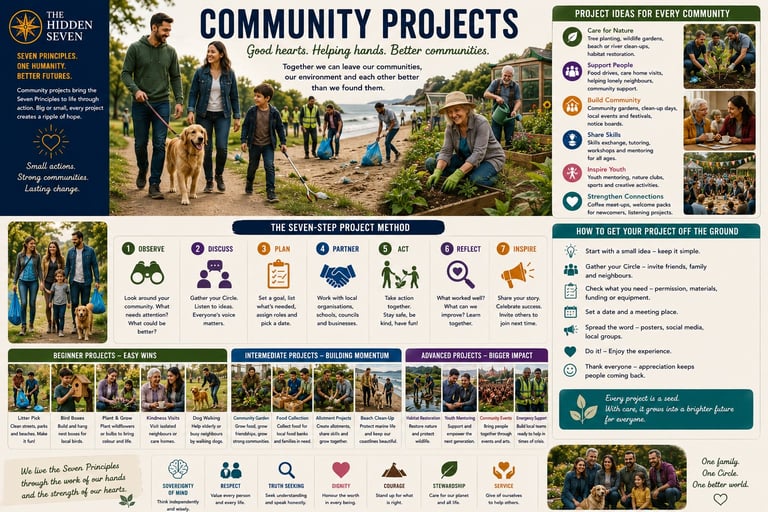
The Seven-Step Project Method
Every Guardian project follows the same simple process.
1. Observe
Walk through your community.
Look carefully.
Notice what others ignore.
Overflowing bins.
Lonely neighbours.
Damaged flower beds.
Litter.
Unused green spaces.
Poor biodiversity.
Children with nowhere safe to play.
Every problem is an opportunity.
2. Discuss
Gather your Circle.
Ask questions.
Listen to different perspectives.
Allow everyone to contribute.
Sometimes the best ideas come from the quietest voices.
3. Plan
Keep your plan simple.
What is the goal?
Who is responsible?
What equipment is needed?
Do we need permission?
How much will it cost?
When will we begin?
Write everything down.
4. Partner
You do not have to work alone.
Many organisations welcome volunteers.
Examples include:
Local councils
Schools
Community centres
Wildlife trusts
Food banks
Churches, mosques, temples and other faith groups
Care homes
Scout and youth organisations
Charities
Local businesses
Working together achieves more.
5. Act
Do the work.
Smile.
Encourage one another.
Take photographs.
Celebrate effort.
Remember—
People remember experiences more than meetings.
6. Reflect
After every project ask:
What worked well?
What surprised us?
What would we improve next time?
Reflection turns experience into wisdom.
7. Inspire
Tell your story.
Share photographs.
Write about the difference made.
Celebrate volunteers.
Invite others to join next time.
Success inspires participation.


Beginner Projects
Every Guardian can begin here.
Community Clean-Up
Organise a litter pick.
Provide gloves and rubbish bags.
Work safely.
Photograph before and after.
Even one clean street inspires others.
Pollinator Planting
Plant native wildflowers.
Create bee-friendly gardens.
Encourage neighbours to join.
Small gardens can become important wildlife corridors.
Bird Feeding and Nesting
Install bird feeders.
Build nest boxes.
Create bird-friendly gardens.
Children especially enjoy helping with these projects.
Smile Campaign
Spend one hour greeting people in your town.
Offer encouragement.
Thank shop workers.
Visit isolated neighbours.
Sometimes kindness is the project.
Library or Book Exchange
Create a free book-sharing shelf.
Donate books.
Encourage reading.
Knowledge strengthens communities.
Intermediate Projects
Once your Circle grows, consider larger projects.
Community Garden
Transform unused land into productive gardens.
Grow vegetables.
Create spaces for wildlife.
Invite schools to participate.
Gardens build both friendships and food security.
Tree Planting
Work with local authorities or conservation groups.
Choose appropriate native species.
Protect young trees.
Return each year to monitor growth.
Planting a tree is an investment in future generations.
Food Collection
Organise regular donations for food banks.
Work with supermarkets.
Encourage neighbours to contribute.
Small collections become significant over time.
Shelter Dog Walking:
Charities like Dogs Trust and RSPCA utilize volunteer dog walkers to provide essential exercise, training, and socialization for dogs waiting in kennels.
Care Home Visits
Organise regular visits.
Read together.
Play games.
Share stories.
Loneliness is one of the greatest challenges facing many older people.
Time is often the greatest gift.
Skills Exchange
Every Guardian has something to teach.
Gardening.
Cooking.
DIY.
First aid.
Languages.
Computer skills.
Photography.
Invite local people to learn from one another.
Communities become stronger when knowledge is shared.


Advanced Projects
Experienced Circles may wish to undertake larger initiatives.
Restore Natural Habitats
Remove invasive plants.
Create ponds.
Restore wetlands.
Plant hedgerows.
Improve biodiversity.
Partner with local conservation organisations.
Community Festivals
Celebrate your neighbourhood.
Invite local musicians.
Artists.
Schools.
Charities.
Food vendors.
Create events that strengthen community spirit.
Youth Mentoring
Support young people through practical skills, confidence building and encouragement.
Positive adult role models can change lives.
Emergency Support Network
Create volunteer teams to assist vulnerable residents during storms, heatwaves or emergencies.
Strong communities prepare before crises happen.
Annual Legacy Project
Choose one significant project each year.
Restore a woodland.
Build a community orchard.
Create a sensory garden.
Fund a scholarship.
Leave something that future generations will inherit.
Working Safely
Guardians serve responsibly.
Always consider:
Personal safety.
Risk assessments.
Insurance where required.
Permissions from landowners.
Safeguarding when working with children or vulnerable adults.
Environmental protection.
The Hidden Seven values enthusiasm—but also wisdom.
Measuring Success
Do not measure success only by numbers.
Ask instead:
Did we help people?
Did we improve nature?
Did we strengthen friendships?
Did we inspire others?
Did our community become slightly better?
These are the measures that matter.
Project Record
Every Circle should keep a simple record.
Project Name
Date
Location
Volunteers
Hours Served
People Helped
Wildlife or Environment Improved
Lessons Learned
Next Steps
Years from now, these records will become the history of your Circle.
The Legacy of Small Actions
A single litter pick cleans one park.
A hundred litter picks change a town.
One tree gives shade.
A thousand trees restore forests.
One volunteer comforts one lonely person.
Thousands of volunteers strengthen society.
Never underestimate what consistent action can achieve.
The Hidden Seven is not remembered for what it believes.
It will be remembered for what its Guardians do.
Carry the Light
Every project begins with one person asking,
"What can I do?"
The answer does not need to be extraordinary.
It only needs to begin.
When enough Guardians take that first step, communities change.
And when communities change...
The world changes with them.
Guardian's Motto
"Do not wait for someone else to improve your community. Be the person who begins."


Handbook Links
How to use handbook
Community Spaces
Governance of The Hidden Seven
The Path of Alignment
Guardian Journey
Living as a Guardian
Guardian Reflections
Community Standards
Guardian Projects
Community Projects
Running a Circle
Becoming a Guide
Why We Exist
The Relationship Between Growth and Progression
Becoming a Beacon
The Seven Paths of Action
Truth Seeking and Respectful Dialogue
FAQ
Connect
Join our journey toward wisdom and freedom
Subscribe
© 2026. All rights reserved.
The Seven Core Principles framework is intended for personal development and informational purposes and should not be considered legal, medical, financial, or psychological advice.
Use of this website is entirely at your own risk.
About Founder
Contact
Accessibility Statement