Truth Seeking
How to Research, Evaluate Evidence and Think Clearly
"The greatest threat to truth is not disagreement. It is believing something without first asking whether it is true."
Why Truth Matters
One of the Seven Principles is Truth Seeking.
Truth is not something we simply possess.
It is something we continually pursue.
Throughout history, humanity has corrected many mistakes.
People once believed the Earth was the centre of the universe.
Doctors once performed surgery without washing their hands.
Entire societies accepted ideas that were later shown to be false.
Progress happens because people are willing to question, investigate and learn.
That journey never ends.
A Guardian is not expected to know everything.
A Guardian is expected to remain curious.
Truth Is a Journey
Very few important questions have simple answers.
Sometimes the evidence is overwhelming.
Sometimes it is incomplete.
Sometimes experts genuinely disagree.
Sometimes new discoveries change what we thought we knew.
Truth Seeking means becoming comfortable saying:
"I don't know yet."
Those four words are often wiser than pretending certainty.
Respect the Person. Examine the Idea.
The Hidden Seven teaches an important distinction.
Every person deserves respect.
Every idea deserves examination.
Someone may sincerely believe something that is incorrect.
Someone may disagree with you and still have valuable evidence.
Attack ideas.
Never attack people.
Listen before responding.
Seek understanding before seeking agreement.
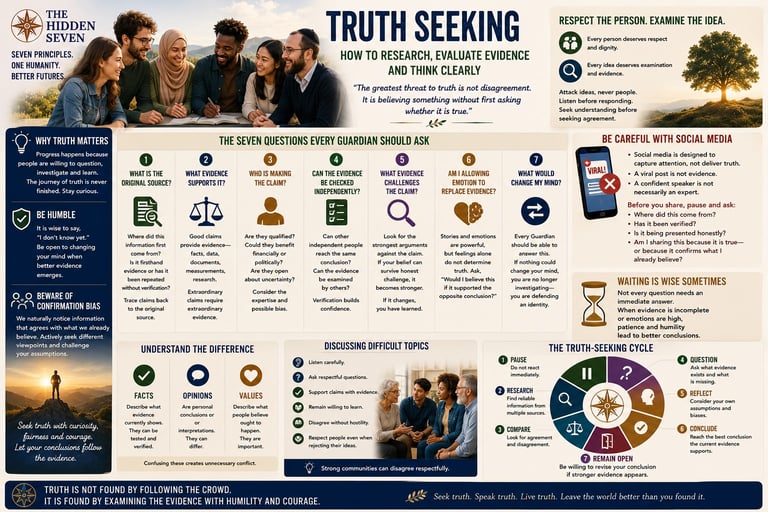
The Seven Questions Every Guardian Should Ask
Before accepting any important claim, ask yourself:
1. What is the original source?
Where did this information first come from?
Is it firsthand evidence?
Or has it been repeated many times without verification?
Always try to trace claims back to their original source.
2. What evidence supports it?
Good claims provide evidence.
Photographs.
Measurements.
Documents.
Reliable observations.
Research.
Independent investigations.
The stronger the evidence, the stronger the confidence.
Extraordinary claims require extraordinary evidence.
3. Who is making the claim?
Everyone has perspectives.
Ask:
Are they qualified?
Are they speaking within their area of expertise?
Could they benefit financially or politically?
Are they open about uncertainty?
Credentials alone do not prove someone is correct.
But genuine expertise deserves careful consideration.
4. Can the evidence be checked independently?
One source is rarely enough.
Can other independent people reach the same conclusion?
Can the evidence be examined by others?
Independent verification builds confidence.
5. What evidence challenges the claim?
Do not only search for information that agrees with your opinion.
Actively look for the strongest arguments against your own position.
If your belief survives honest challenge, it becomes stronger.
If it changes, you have learned something valuable.
6. Am I allowing emotion to replace evidence?
Powerful stories move us.
Emotion matters.
But feelings alone do not determine whether something is true.
Ask yourself:
"Would I believe this if it supported the opposite conclusion?"
Honest self-reflection protects us from bias.
7. What would change my mind?
Every Guardian should be able to answer this question.
If nothing could ever change your mind...
You are no longer investigating.
You are defending an identity.
Truth Seeking requires humility.
Be Careful with Social Media
Social media is designed to capture attention.
Attention is not the same as truth.
A post may receive millions of views and still be completely false.
A confident speaker is not necessarily a knowledgeable speaker.
A viral video is not evidence.
Before sharing information, pause and ask:
Where did this come from?
Has it been verified?
Is it being presented honestly?
Am I sharing this because it is true—or because it confirms what I already believe?
Guardians understand that every share carries responsibility.
Understand Confirmation Bias
Human beings naturally notice information that agrees with what they already believe.
This is called confirmation bias.
It affects everyone.
Scientists.
Journalists.
Teachers.
Politicians.
Parents.
Guardians.
Recognising this bias helps us become better thinkers.
The best way to reduce it is to actively seek thoughtful disagreement.
Learn the Difference Between Facts, Opinions and Values
A healthy discussion often contains all three.
Facts describe what evidence currently shows.
Opinions are personal conclusions or interpretations.
Values describe what people believe ought to happen.
Confusing these creates unnecessary conflict.
A Guardian tries to recognise which type of conversation is taking place.
Beware of False Certainty
People often speak with absolute confidence.
Confidence can be persuasive.
It is not proof.
Some of the wisest people in history frequently changed their minds as new evidence emerged.
Confidence should never replace investigation.
Waiting Is Sometimes the Wisest Choice
Not every question needs an immediate answer.
Sometimes the evidence is incomplete.
Sometimes emotions are running high.
Sometimes reliable information has not yet emerged.
In these moments, patience is wisdom.
A Guardian is comfortable saying:
"I need to learn more before reaching a conclusion."
Waiting is not weakness.
It is intellectual discipline.
Discussing Difficult Topics
Subjects such as health, politics, history, ethics, religion and science often involve deeply held beliefs.
The Hidden Seven does not ask Guardians to agree on every issue.
Instead, it asks them to:
Listen carefully.
Ask respectful questions.
Support claims with evidence.
Remain willing to learn.
Accept uncertainty where it exists.
Disagree without hostility.
Respect people even when rejecting their ideas.
Strong communities can disagree respectfully.
The Truth-Seeking Cycle
Whenever you encounter an important claim, follow this simple process:
Pause – Do not react immediately.
Research – Find reliable information from multiple sources.
Compare – Look for agreement and disagreement.
Question – Ask what evidence exists and what is missing.
Reflect – Consider your own assumptions and biases.
Conclude – Reach the best conclusion the current evidence supports.
Remain Open – Be willing to revise your conclusion if stronger evidence appears.
This cycle is never truly finished.
Learning continues throughout life.
The Guardian's Standard
A Guardian does not measure truth by:
Popularity.
Political loyalty.
Tradition alone.
Celebrity endorsements.
Loud voices.
Viral posts.
Personal preference.
A Guardian measures confidence by the quality of the available evidence while remaining humble enough to recognise that knowledge can grow.
Carry the Light
The Hidden Seven does not ask you to stop questioning.
It asks you to question more carefully.
Not to win arguments.
But to understand reality more clearly.
The pursuit of truth is not a destination.
It is a lifelong habit of curiosity, humility and honesty.
Every question asked with integrity brings a little more light into the world.
Guardian's Reflection
"Do not believe something because it is popular. Do not reject something because it is unpopular. Do not feel the need to prove someone wrong. Examine the evidence, question with humility, and let your conclusions follow where the best available evidence leads."
We do not ask Guardians what conclusions they must reach. We ask them to pursue truth with intellectual honesty, examine evidence with humility, and treat those who disagree with dignity and respect


Handbook Links
How to use handbook
Community Spaces
Governance of The Hidden Seven
The Path of Alignment
Guardian Journey
Living as a Guardian
Guardian Reflections
Community Standards
Guardian Projects
Community Projects
Running a Circle
Becoming a Guide
Why We Exist
The Relationship Between Growth and Progression
Becoming a Beacon
The Seven Paths of Action
Truth Seeking and Respectful Dialogue
FAQ
Connect
Join our journey toward wisdom and freedom
Subscribe
© 2026. All rights reserved.
The Seven Core Principles framework is intended for personal development and informational purposes and should not be considered legal, medical, financial, or psychological advice.
Use of this website is entirely at your own risk.
About Founder
Contact
Accessibility Statement