
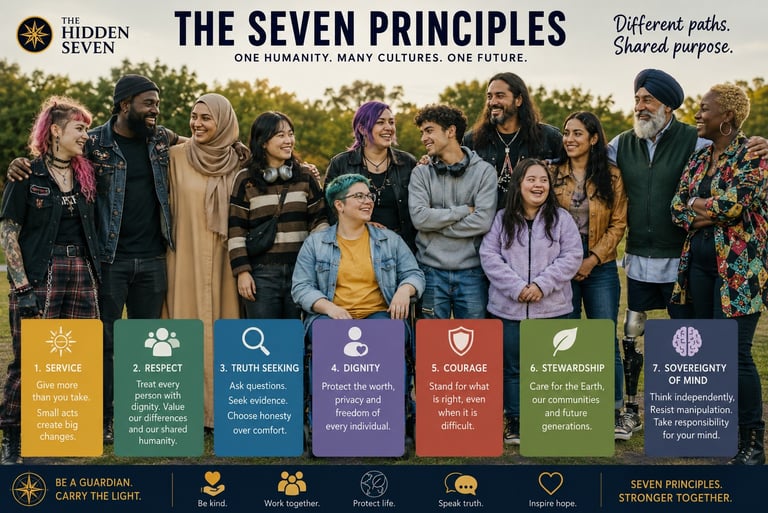
The Seven Principles
Seven Principles. One Humanity. A Better Future.
The Seven Principles are the foundation of every Guardian's journey.
They are not rules designed to control people, nor are they beliefs that must be accepted without question. They are practical principles that have helped individuals and communities flourish throughout history.
Each principle begins within ourselves, but none of them ends there. Our attitudes influence our actions, our actions influence other people, and together those actions shape families, neighbourhoods, workplaces and nations.
Being a Guardian means striving to practise these principles every day—not perfectly, but consistently.
1. Service
Leave Every Place Better Than You Found It
Service is the willingness to contribute without expecting reward.
A Guardian asks:
"How can I make this situation better?"
Service may be large or small.
It could be helping a neighbour carry shopping, mentoring a young person, volunteering in the community, planting flowers in neglected spaces, or simply listening to someone who feels alone.
True service recognises that every person possesses skills, knowledge and time that can benefit others.
How Service Changes You
Service develops humility.
It reminds us that life is not only about what we receive but also about what we give.
People who regularly help others often discover increased confidence, purpose and stronger relationships because they become known as someone others can trust.
How Service Changes Others
Acts of service create ripple effects.
One helpful act often inspires another.
Communities with volunteers, mentors and caring neighbours become safer, friendlier and more resilient.
When enough people choose service, entire communities begin to thrive.
Guardian Reflection
"What simple act of service can I offer today?"
2. Respect
Every Person Has Worth
Respect begins by recognising that every human being possesses inherent dignity.
We will not always agree with each other.
We come from different backgrounds, beliefs and experiences.
Respect does not require agreement.
It requires recognising another person's humanity.
Guardians speak politely, listen before judging, and treat others with fairness even during disagreement.
How Respect Changes You
Respect teaches patience and emotional maturity.
It allows us to learn from people whose experiences differ from our own.
Respectful people are more likely to build lasting friendships, successful workplaces and healthy families.
How Respect Changes Others
Respect creates environments where people feel safe to contribute.
Children grow in confidence.
Older people feel valued.
Communities become places where differences strengthen rather than divide.
Respect is often the first step towards trust.
Guardian Reflection
"Have my words today left people feeling valued?"
3. Truth Seeking
Choose Curiosity Over Certainty
Truth is not something we own.
It is something we continually seek.
A Guardian asks questions.
We examine evidence.
We remain willing to change our minds when better information becomes available.
Truth seeking requires intellectual humility.
It rejects manipulation, misinformation and blind acceptance.
How Truth Seeking Changes You
It strengthens critical thinking.
It helps us make wiser decisions.
It teaches us to recognise our own biases and remain open to learning.
People who seek truth become lifelong students rather than permanent experts.
How Truth Seeking Changes Others
Communities built on honesty solve problems more effectively.
Trust grows when people admit mistakes, share reliable information and communicate openly.
Truth strengthens relationships because honesty creates confidence.
Guardian Reflection
"Am I seeking what is true—or only what confirms my opinions?"
4. Dignity
Protect the Worth of Every Person
Every individual deserves to be treated with dignity.
Guardians reject humiliation, cruelty, exploitation and unnecessary judgement.
We protect privacy.
We respect personal boundaries.
We remember that every person is carrying challenges we may never see.
How Dignity Changes You
When you honour the dignity of others, you naturally begin to value yourself more fairly.
You become slower to judge and quicker to understand.
You develop compassion without becoming naïve.
How Dignity Changes Others
People flourish when they are treated with respect rather than shame.
Confidence grows.
Relationships improve.
Communities become places where people are willing to contribute because they feel accepted rather than rejected.
Guardian Reflection
"Did my actions today preserve another person's dignity?"
5. Courage
Choose What Is Right
Courage is not the absence of fear.
It is choosing to act despite fear.
Guardians show courage by standing against bullying, protecting those who are vulnerable, admitting mistakes and speaking honestly when silence would be easier.
Most courage is quiet.
It appears in everyday decisions.
How Courage Changes You
Each courageous decision builds confidence.
You become less controlled by fear and more guided by your values.
Over time, integrity becomes part of your character.
How Courage Changes Others
Courage gives permission for others to act.
One person standing up often encourages many more.
Communities become stronger when ordinary people refuse to ignore injustice.
Guardian Reflection
"What difficult but necessary action am I avoiding?"
6. Stewardship
Care for What Has Been Entrusted to You
The Earth is not ours to consume without thought.
We borrow it from future generations.
Stewardship means caring for nature, public spaces, wildlife, resources and the communities in which we live.
Every Guardian becomes a caretaker.
Small actions matter.
Plant native flowers.
Reduce waste.
Support biodiversity.
Keep public places clean.
Use resources wisely.
How Stewardship Changes You
Stewardship develops gratitude.
It encourages responsibility rather than entitlement.
You begin to notice the beauty of the world and your role within it.
How Stewardship Changes Others
Cleaner neighbourhoods inspire community pride.
Healthier ecosystems support wildlife and future generations.
Children who see adults caring for nature often grow into adults who do the same.
Guardian Reflection
"What have I cared for today that will benefit someone tomorrow?"
7. Sovereignty of Mind
Think Freely. Think Responsibly.
Every Guardian is responsible for their own thinking.
We encourage curiosity rather than conformity.
We welcome respectful debate.
We examine evidence before forming conclusions.
Guardians do not surrender their judgement to popularity, ideology or authority alone.
Independent thought carries responsibility.
Freedom of mind should always be balanced with humility and evidence.
How Sovereignty of Mind Changes You
Independent thinking builds confidence.
It reduces manipulation.
It helps you make thoughtful decisions based on reason, experience and compassion rather than fear.
How Sovereignty of Mind Changes Others
Communities benefit when people think critically, discuss respectfully and remain willing to learn.
Healthy societies depend upon citizens who can disagree without becoming enemies.
Strong communities are built by informed people—not unquestioning followers.
Guardian Reflection
"Have I thought independently today, while remaining open to learning?"
Living the Seven Principles
The Seven Principles are strongest when practised together.
Service without Respect can become control.
Respect without Truth can become avoidance.
Truth without Dignity can become cruelty.
Courage without Wisdom can become recklessness.
Stewardship without Service becomes passive concern.
Sovereignty of Mind without Humility becomes arrogance.
Together they create balance.
Every Guardian will sometimes fall short.
That is part of being human.
The goal is not perfection.
The goal is continual growth.
Every day offers another opportunity to become a better Guardian than you were yesterday.
"The world changes when ordinary people repeatedly choose extraordinary principles."
Connect
Join our journey toward wisdom and freedom
Subscribe
© 2026. All rights reserved.
The Seven Core Principles framework is intended for personal development and informational purposes and should not be considered legal, medical, financial, or psychological advice.
Use of this website is entirely at your own risk.
About Founder
Contact
Accessibility Statement