
DIY Bee Hotel: How to Build a Safe Home for Solitary Bees
Learn how to build a simple bee hotel for gentle solitary bees like Red Mason and Leafcutter bees. Support pollinators, biodiversity, and your local ecosystem with this easy DIY Guardian project.
WILDLIFE
Keeper of the Vision
7/12/20263 min read
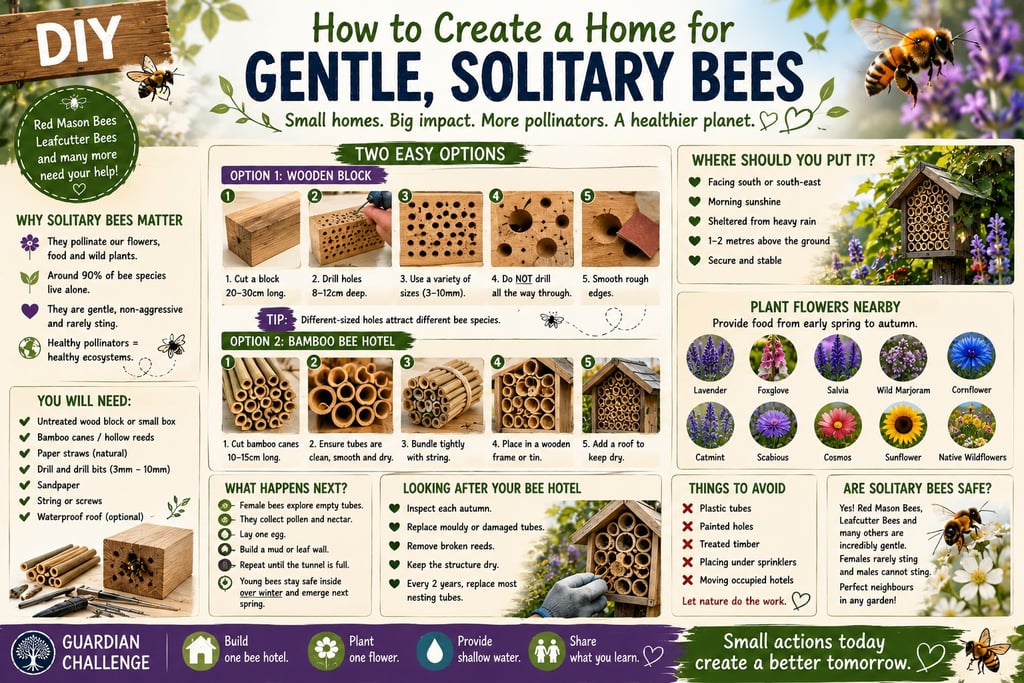
DIY Bee Hotel: How to Create a Safe Home for Gentle Solitary Bees
Small Homes. Big Impact.
When most people think of bees, they imagine large hives full of honeybees.
But around 90% of bee species in the UK live alone.
These remarkable insects are known as solitary bees, and they are some of the most important pollinators in our gardens.
Unlike honeybees, they do not live in colonies, produce honey, or defend a queen.
They simply collect pollen, lay eggs, and quietly help flowers, fruit trees and vegetables thrive.
Species such as the Red Mason Bee (Osmia bicornis) and Leafcutter Bee (Megachile species) are gentle, fascinating visitors that rarely sting and pose very little risk to people.
By building a simple bee hotel, you can provide a safe nesting place while supporting local biodiversity.
A Guardian understands that protecting nature often begins with the smallest acts.
Why Solitary Bees Matter
Solitary bees pollinate:
Apple trees
Pear trees
Strawberries
Blackberries
Tomatoes
Wildflowers
Herbs
Many native plants
Healthy pollinator populations support healthy ecosystems, food production, and wildlife.
Without them, many plants simply could not reproduce.
What You'll Need
Most materials can be recycled or found naturally.
Materials
Untreated wooden block or a small wooden box
Hollow bamboo canes
Reed stems
Paper straws (natural paper only)
Hand drill
Drill bits between 3 mm and 10 mm
Sandpaper
String or screws for mounting
Waterproof roof (optional)
Avoid treated timber or painted wood inside the nesting holes.
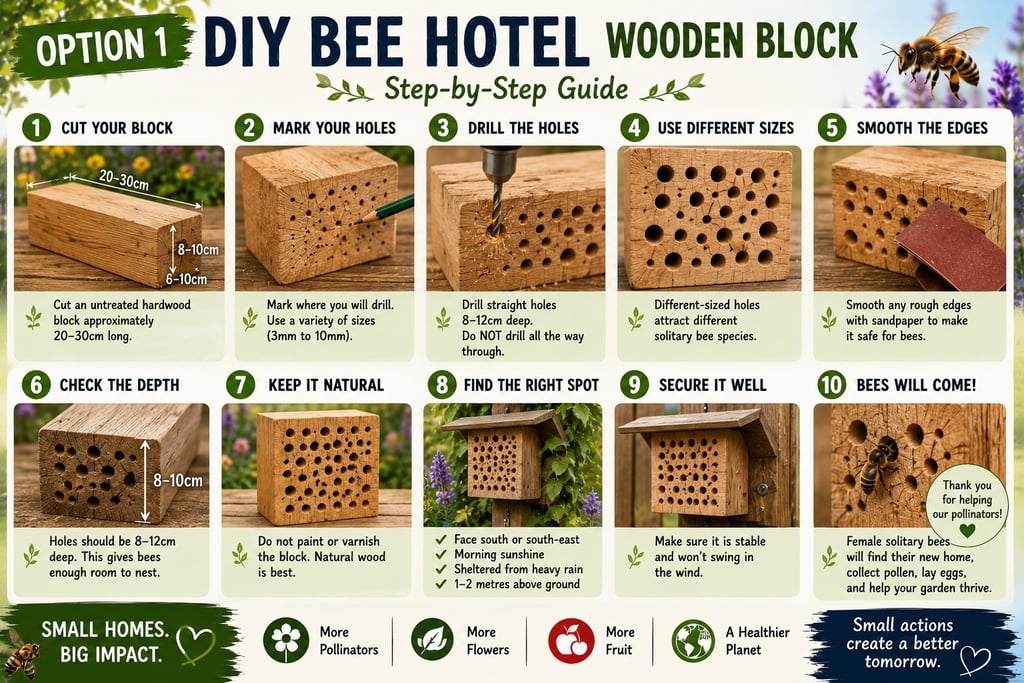
Option One – The Wooden Block
Using untreated hardwood:
Cut a block approximately 20–30 cm long.
Drill holes 8–12 cm deep.
Use a variety of hole sizes (3–10 mm).
Do not drill all the way through.
Smooth rough edges with sandpaper.
Different-sized holes attract different bee species.
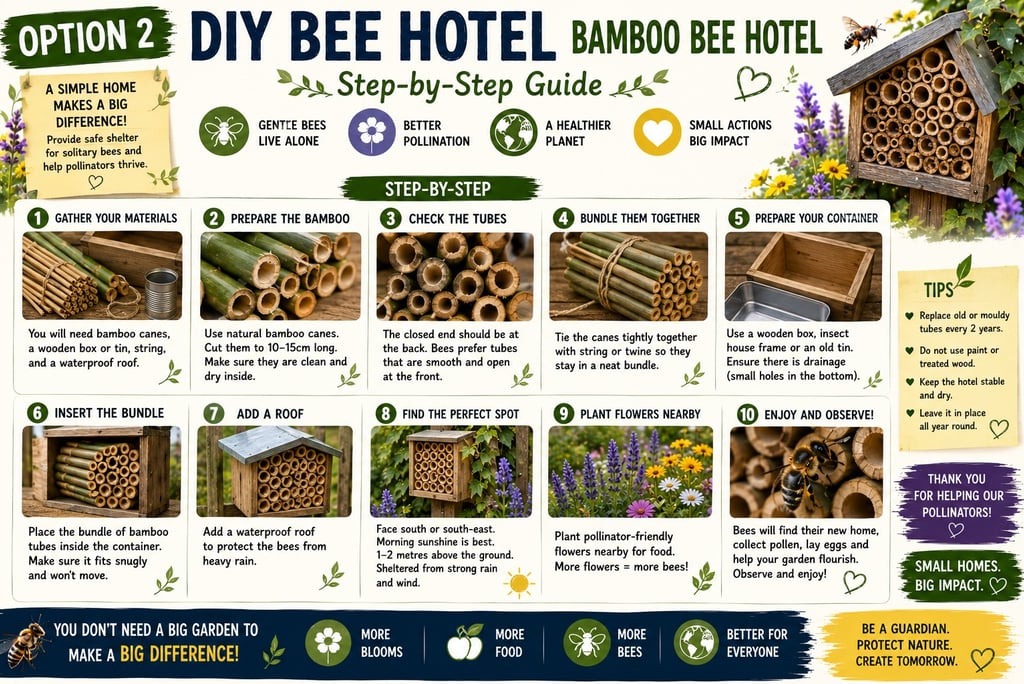
Option Two – Bamboo Bee Hotel
Bundle together bamboo canes with one closed end.
Each tube should be:
10–15 cm long
Clean inside
Dry
Smooth
Tie them tightly together and place them inside a wooden frame or old tin (with drainage).
Where Should You Put It?
Choose somewhere:
✅ Facing south or south-east
✅ Morning sunshine
✅ Sheltered from heavy rain
✅ About 1–2 metres above the ground
✅ Securely fixed so it doesn't swing
Bees prefer stable homes.
Plant Flowers Nearby
A nesting site is only useful if food is close by.
Excellent plants include:
Lavender
Foxgloves
Salvia
Wild marjoram
Catmint
Cornflowers
Scabious
Cosmos
Sunflowers
Native wildflowers
Aim for flowers blooming from early spring until autumn.
What Happens Next?
Female solitary bees will:
Explore empty tubes.
Collect pollen and nectar.
Lay one egg.
Build a mud or leaf wall.
Repeat until the tunnel is full.
Each chamber contains enough food for a developing larva.
The young bees remain safely inside over winter before emerging the following spring.
Looking After Your Bee Hotel
Each autumn:
Inspect for damage.
Replace mouldy bamboo.
Remove broken tubes.
Keep the structure dry.
Every two years it's worth replacing most nesting tubes to reduce parasites and disease.
Things to Avoid
Avoid:
❌ Plastic tubes
❌ Painted nesting holes
❌ Pressure-treated timber
❌ Placing hotels directly under sprinklers
❌ Moving occupied hotels
Let nature do the work.
Are Solitary Bees Safe?
Yes.
Red Mason Bees and Leafcutter Bees are incredibly gentle.
Females possess a sting but almost never use it because they have no colony to defend.
Males cannot sting at all.
This makes solitary bees excellent garden neighbours and wonderful insects for children to observe from a respectful distance.
Become a Guardian of Pollinators
Building a bee hotel may take less than an hour.
Yet it can provide shelter for hundreds of bees over its lifetime.
Small actions, repeated across thousands of gardens, become something much larger.
They create habitats.
They restore biodiversity.
They strengthen ecosystems.
And they leave the world better than we found it.
Guardian Challenge
This week:
Build one bee hotel.
Plant one pollinator-friendly flower.
Leave a shallow dish of water with small stones for insects to land on safely.
Share what you've learned with a friend or neighbour.
Together, these simple acts help ensure that future generations inherit a world still buzzing with life.


Reflection
If a tiny solitary bee can help feed forests, farms, and gardens without asking for recognition, what small act could you do today that quietly helps the world around you?
Connect
Join our journey toward wisdom and freedom
Subscribe
© 2026. All rights reserved.
The Seven Core Principles framework is intended for personal development and informational purposes and should not be considered legal, medical, financial, or psychological advice.
Use of this website is entirely at your own risk.
About Founder
Contact
Accessibility Statement