How to Find Real Community in a Connected but Lonely World
Find community, build community, belonging, loneliness, community groups, and strong communities,t description.
COMMUNITY
Keeper of the Light
7/15/20264 min read
How to Find Real Community in a Connected but Lonely World
One Humanity. One Future. Countless Guardians.
Never before in human history have we been so connected through technology, yet so many people feel profoundly alone.
We can send messages across the world in seconds. We can follow thousands of people online. We can join countless social media groups.
Yet millions of people still finish each day feeling unseen, unheard, and disconnected.
Why?
Because connection and community are not the same thing.
We Were Designed to Belong
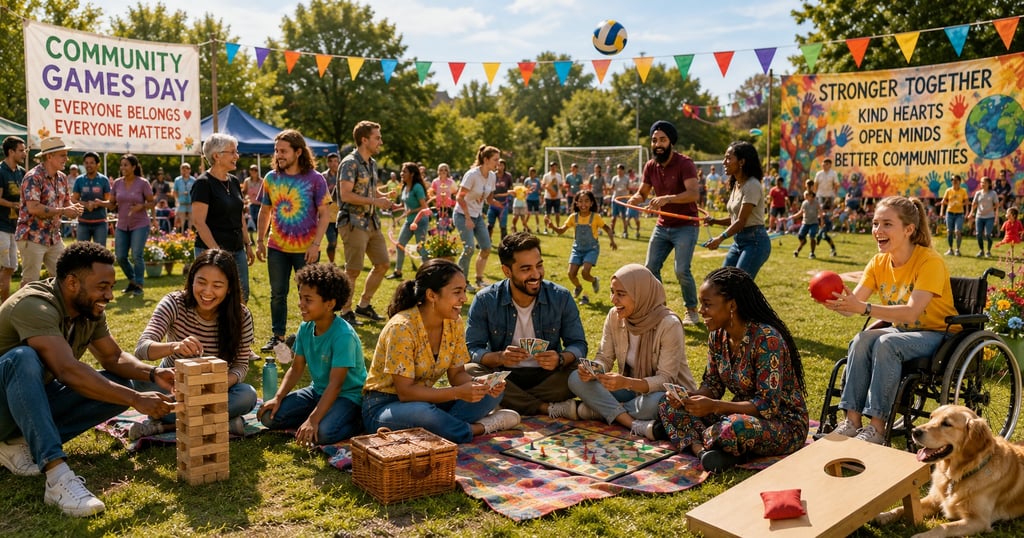
For thousands of years, people lived in villages, tribes and neighbourhoods where everyone knew each other.
Children grew up surrounded by grandparents.
Neighbours helped one another during difficult times.
Meals were shared.
Skills were passed from generation to generation.
People felt that they mattered because they were needed.
Modern life has changed much of this.
Many people work remotely, move frequently, spend evenings online and barely know the people living next door.
The result isn't simply loneliness.
It's the loss of belonging.
Community Doesn't Happen by Accident
Many people wait for friendship to happen naturally.
Unfortunately, adult life rarely works that way.
Strong communities are created by ordinary people making small, consistent choices.
Someone has to say hello first.
Someone has to organise the coffee morning.
Someone has to invite neighbours together.
Someone has to pick up the litter.
Someone has to volunteer.
Someone has to care enough to begin.
Every thriving community started because one person decided to take the first step.
The Myth of the Perfect Community
Many people spend years searching for the perfect group.
The perfect club.
The perfect organisation.
The perfect friends.
But healthy communities aren't discovered.
They're built.
Every lasting community contains people who disagree sometimes.
People make mistakes.
Conversations become awkward.
Plans occasionally fail.
What matters isn't perfection.
It's commitment.
Communities become stronger when people continue showing up.
Consistency Creates Belonging
Belonging rarely happens during the first meeting.
It develops through repetition.
The people you greet every Saturday at the local park.
The volunteers you work beside every month.
The neighbours you wave to every morning.
The friends you meet regularly for coffee.
Trust grows one conversation at a time.
The more familiar people become, the more naturally friendships develop.
Community isn't built in dramatic moments.
It's built through ordinary Tuesdays.
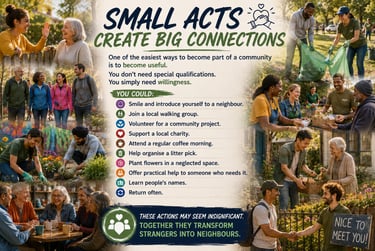
Small Acts Create Big Connections
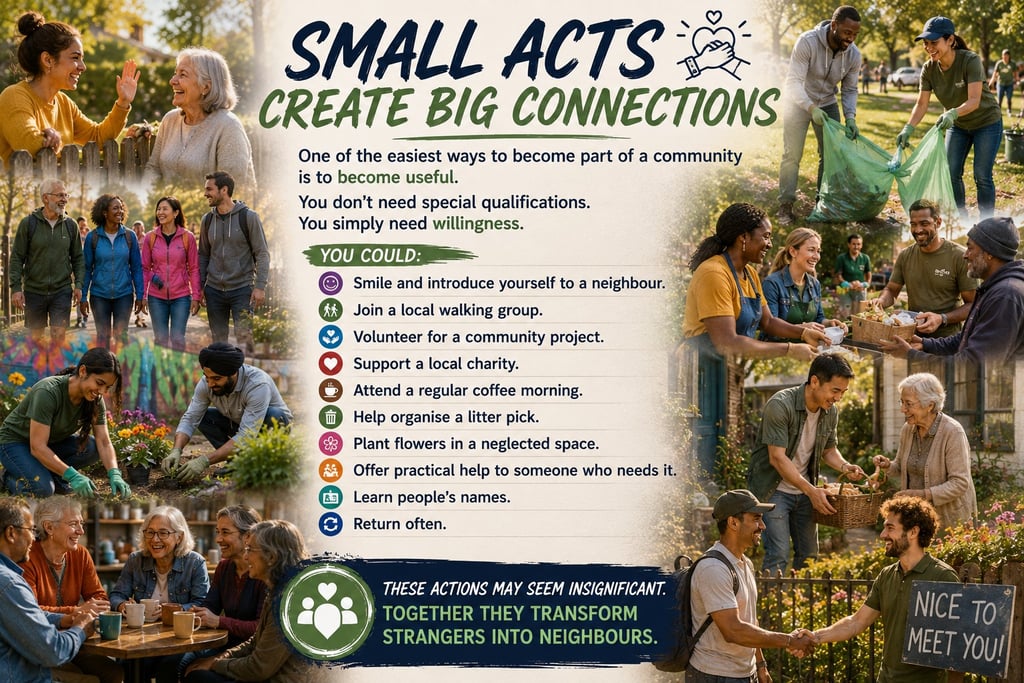
One of the easiest ways to become part of a community is to become useful.
You don't need special qualifications.
You simply need willingness.
You could:
Smile and introduce yourself to a neighbour.
Join a local walking group.
Volunteer for a community project.
Support a local charity.
Attend a regular coffee morning.
Help organise a litter pick.
Plant flowers in a neglected space.
Offer practical help to someone who needs it.
Learn people's names.
Return often.
These actions may seem insignificant.
Together they transform strangers into neighbours.
Digital Communities Have Their Place
Online communities can be wonderful.
They help people with shared interests find one another.
They support people living in remote areas.
They connect those who might otherwise feel isolated.
For many people, online friendships are deeply meaningful.
But screens cannot completely replace face-to-face human connection.
Sharing laughter around a table.
Working together on a project.
Walking through a local park.
Celebrating achievements together.
These experiences create memories that digital conversations rarely match.
The strongest communities often combine both worlds—using technology to organise people while encouraging real-world relationships.
Why The Hidden Seven Exists
The Hidden Seven believes stronger communities begin with stronger people.
Not through ideology.
Not through politics.
Not through perfection.
But through ordinary people choosing to become Guardians of their communities.
A Guardian asks simple questions:
How can I help today?
Who needs encouragement?
What can I improve?
How can I leave this place better than I found it?
When thousands of people begin asking those questions, neighbourhoods change.
Cities change.
Countries change.
Start With Seven People
Many people imagine that changing the world requires thousands of supporters.
History suggests otherwise.
Almost every great movement began with a small group of committed people.
A handful of friends.
A family.
Work colleagues.
Neighbours.
A sports team.
A coffee morning.
A walking group.
A book club.
That's why Hidden Seven encourages the formation of local Circles.
A Circle doesn't need a building.
It doesn't need expensive equipment.
It simply needs people who care enough to meet regularly, support one another and improve the place they call home.
The Future of Community
The world doesn't need more division.
It needs more belonging.
It doesn't need more anonymous crowds.
It needs more neighbours who know each other's names.
Community is not something we inherit.
It is something we create.
Every conversation matters.
Every shared meal matters.
Every act of kindness matters.
Every volunteer matters.
Every Guardian matters.
The question is not whether community still exists.
The question is whether each of us is willing to help build it.
Because the strongest communities are never found.
They are created—one person, one conversation and one act of service at a time.
Reflection
Who could become part of your community if you simply introduced yourself today


Connect
Join our journey toward wisdom and freedom
Subscribe
© 2026. All rights reserved.
The Seven Core Principles framework is intended for personal development and informational purposes and should not be considered legal, medical, financial, or psychological advice.
Use of this website is entirely at your own risk.
About Founder
Contact
Accessibility Statement