
AI and the Future of Humanity: Opportunity or Risk?
Explore how artificial intelligence could transform medicine, education, work and society while examining the ethical questions shaping humanity's future.
AI AND TECHNOLOGY
Keeper of the Vision
7/24/20264 min read
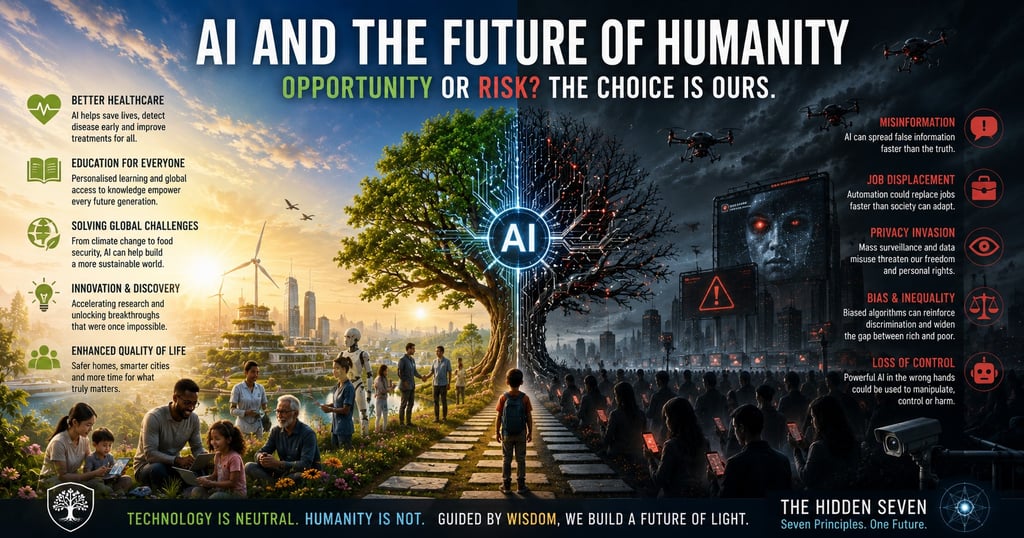
AI and the Future of Humanity: Opportunity or Risk?
Artificial Intelligence is no longer a vision of the future.
It is already helping doctors diagnose disease, translating languages instantly, assisting scientists in discovering new medicines, and changing how millions of people work every day.
Some believe AI will become humanity's greatest achievement.
Others fear it could become one of its greatest challenges.
So which is true?
The honest answer is that nobody knows with certainty.
Artificial Intelligence is neither inherently good nor inherently bad.
Like every powerful technology before it, its impact depends on the people who design it, regulate it, and choose how to use it.
The real question is not whether AI is coming.
It already has.
The question is whether humanity will develop the wisdom to guide it responsibly.
What Is Artificial Intelligence?
Artificial Intelligence (AI) refers to computer systems capable of performing tasks that normally require human intelligence.
These include:
Understanding language.
Recognising images.
Learning from experience.
Solving complex problems.
Creating text, music and artwork.
Assisting with scientific research.
Modern AI is advancing at an extraordinary pace.
Tasks that once took teams of experts can now be completed in minutes.
That has enormous potential—but also enormous responsibility.
The Opportunities
Transforming Healthcare
AI is already helping doctors detect cancers earlier, identify diseases from medical scans, accelerate drug discovery, and personalise treatments.
Future systems could reduce diagnostic errors, improve patient outcomes, and make healthcare more accessible around the world.
Accelerating Scientific Discovery
Researchers are using AI to analyse huge datasets that humans simply cannot process alone.
From climate science to astronomy, AI is helping uncover patterns that may lead to breakthroughs in medicine, energy, agriculture and environmental conservation.
Education for Everyone
Imagine every child having access to a personalised tutor that adapts to their learning style.
AI has the potential to make high-quality education more affordable and accessible, regardless of where someone lives.
Protecting the Environment
Artificial Intelligence can help monitor endangered wildlife, predict wildfires, optimise renewable energy, reduce waste, and improve food production while using fewer natural resources.
Used wisely, AI could become one of humanity's greatest tools for protecting the planet.
Improving Daily Life
Navigation systems, accessibility tools, language translation, fraud detection, emergency response, and countless other services already rely on AI.
Many people use artificial intelligence every day without even realising it.
The Risks
Every major technological revolution has created new challenges.
Artificial Intelligence is no different.
Misinformation
AI can generate convincing text, images, audio and video in seconds.
While this offers creative opportunities, it also makes misinformation, deepfakes and scams more difficult to identify.
Learning to evaluate evidence has never been more important.
Employment
Automation may replace certain jobs while creating entirely new industries.
History suggests technological revolutions usually generate new opportunities, but the transition can be difficult for workers whose skills become less relevant.
Preparing people through education and lifelong learning will be essential.
Privacy
AI systems rely on enormous amounts of data.
Questions about personal privacy, surveillance, consent and digital rights will become increasingly important.
People should understand how their information is collected, stored and used.
Bias and Fairness
Artificial Intelligence learns from data created by humans.
If that data contains bias, AI systems may unintentionally reinforce unfair outcomes.
Developing transparent and accountable systems is critical.
Concentration of Power
A small number of organisations currently possess the computing resources and expertise needed to build the world's most advanced AI systems.
This raises important questions about accountability, transparency and democratic oversight.
The Ethical Questions
Perhaps the greatest challenge is not technical.
It is ethical.
Questions society must answer include:
Who should control advanced AI?
How can innovation remain open while protecting public safety?
How do we ensure AI benefits everyone rather than a privileged few?
What responsibilities do developers have?
How should governments regulate increasingly powerful systems?
How do we preserve human creativity and meaningful work?
These questions have no simple answers.
They require ongoing discussion between scientists, governments, educators, businesses and the public.
What Does The Hidden Seven Think?
The Hidden Seven does not see AI as something to fear or blindly celebrate.
Instead, we believe every powerful technology should be guided by enduring human values.
The Seven Principles provide a practical framework.
Service
Does this technology genuinely improve people's lives?
Respect
Does it benefit people fairly, regardless of background or circumstance?
Truth Seeking
Are decisions based on evidence rather than hype, fear or misinformation?
Dignity
Does AI respect human autonomy, privacy and worth?
Courage Without Hatred
Can we discuss difficult issues honestly without becoming divided?
Stewardship
What long-term effects will today's decisions have on future generations?
Sovereignty of Mind
Does AI empower independent thinking—or encourage dependence, manipulation and loss of personal freedom?
Technology should strengthen humanity, not replace the qualities that make us human.
The Future Will Be Built by Choices
Artificial Intelligence is not destiny.
Its future depends on millions of individual choices made by researchers, engineers, educators, lawmakers, businesses and citizens.
The algorithms we create today will influence the society our children inherit tomorrow.
That means every decision matters.
Whether AI becomes humanity's greatest tool or one of its greatest mistakes depends less on the technology itself and more on the values that guide its development.
Final Thoughts
Artificial Intelligence represents one of the most important turning points in human history.
It has the potential to cure diseases, expand knowledge, improve lives and help solve global challenges.
It also has the potential to deepen inequality, spread misinformation and concentrate power if developed without ethical safeguards.
The future has not yet been written.
Technology will shape what is possible.
Human wisdom will determine what is right.
Perhaps that is the greatest challenge of all.
Connect
Join our journey toward wisdom and freedom
Subscribe
© 2026. All rights reserved.
The Seven Core Principles framework is intended for personal development and informational purposes and should not be considered legal, medical, financial, or psychological advice.
Use of this website is entirely at your own risk.
About Founder
Contact
Accessibility Statement