
Brain-Computer Interfaces Explained: How They Work and What They Mean for Humanity
Discover how brain-computer interfaces work, their medical benefits, ethical challenges, and the future of connecting the human brain with technology.
AI AND TECHNOLOGY
Keeper of the Vision
7/24/20264 min read
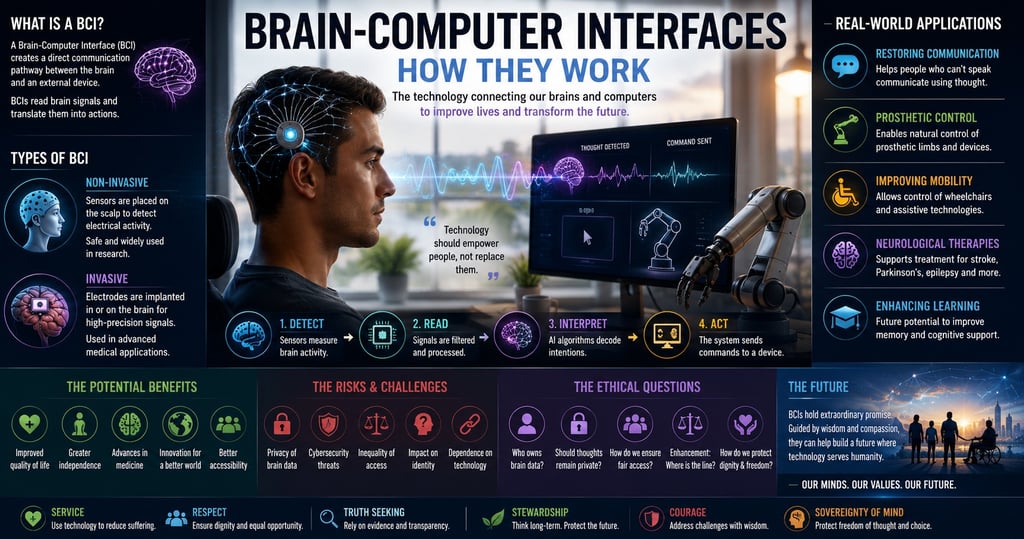
Brain-Computer Interfaces: How They Work
Imagine typing without using a keyboard.
Moving a robotic arm simply by thinking.
Helping someone paralysed speak again after losing the ability to talk.
These ideas once belonged to science fiction.
Today, they are becoming scientific reality through Brain-Computer Interfaces (BCIs).
Around the world, researchers are developing systems that allow the human brain to communicate directly with computers and electronic devices.
The technology is still in its early stages, but its potential could transform medicine, communication and disability support.
At the same time, it raises important questions about privacy, ethics and what it means to be human.
What Is a Brain-Computer Interface?
A Brain-Computer Interface is a system that creates a direct communication pathway between the brain and an external device.
Instead of relying on muscles to press keys, move a mouse or speak words, a BCI interprets electrical activity generated by the brain and converts it into computer commands.
In simple terms:
Think → Detect → Interpret → Act
Your brain produces tiny electrical signals whenever you think, move or imagine movement.
Sensors detect those signals.
Artificial intelligence analyses the patterns.
The computer then carries out the intended action.
How Do Brain-Computer Interfaces Work?
Most BCIs follow four basic stages.
1. Detecting Brain Activity
The first step is measuring electrical signals produced by the brain.
Some systems use sensors placed on the scalp (non-invasive BCIs).
Others use tiny implanted electrodes placed directly on or inside the brain (invasive BCIs), which can provide more detailed signals but require surgery.
2. Reading the Signals
The recorded signals appear as complex patterns of electrical activity.
Advanced software filters background noise and identifies patterns associated with specific thoughts or intended movements.
3. Artificial Intelligence Interpretation
Machine learning algorithms learn to recognise individual patterns.
For example, thinking about moving your left hand produces different activity from imagining moving your right hand.
Over time, the system becomes better at recognising the user's intentions.
4. Performing an Action
Once interpreted, the computer sends instructions to another device.
This might include:
Moving a computer cursor
Controlling a robotic arm
Operating a wheelchair
Typing text
Speaking through a speech synthesiser
Controlling smart home devices
The result is communication without traditional physical movement.


Real-World Applications
Brain-computer interfaces are already helping researchers improve people's lives.
Restoring Communication
Some people who have lost the ability to speak due to neurological conditions may be able to communicate using BCIs that convert intended speech into text or computer-generated voice.
Helping Paralysed Patients
Individuals with severe spinal cord injuries may eventually control computers, robotic limbs or assistive devices through thought alone.
Prosthetic Limbs
Modern robotic arms can already respond to signals generated by the user's nervous system.
Future BCIs may make these movements even more natural.
Stroke Rehabilitation
Researchers are studying whether BCIs can help retrain damaged neural pathways after strokes by encouraging the brain to form new connections.
Scientific Discovery
Understanding how the brain communicates may improve treatments for epilepsy, Parkinson's disease, depression and other neurological disorders.
The Benefits
Brain-computer interfaces could dramatically improve quality of life.
Potential benefits include:
Greater independence for disabled people.
Faster communication.
Improved rehabilitation after injury.
Better understanding of neurological diseases.
More personalised medical treatments.
New opportunities for education and accessibility.
For many researchers, the greatest goal is reducing human suffering.
The Risks
Like every emerging technology, BCIs raise important concerns.
Privacy
If technology can interpret brain activity, how should that information be protected?
Brain data may become one of the most personal forms of information humanity has ever collected.
Security
Could connected brain devices eventually become vulnerable to cyber attacks?
Protecting medical devices from unauthorised access will be essential.
Equality
Advanced brain technologies may initially be expensive.
Ensuring fair access will become an important social challenge.
Human Identity
If technology enhances memory, learning or communication, how might it change the way people understand themselves?
These questions move beyond engineering into philosophy.
Dependence
As people rely increasingly on advanced technology, maintaining human independence and resilience will remain important.
Technology should empower people—not make them dependent.
The Ethical Questions
Brain-computer interfaces force us to consider questions previous generations never imagined.
Who owns brain data?
Should thoughts remain completely private?
Can enhancement become unfair?
How should governments regulate BCIs?
What rights should users have?
Should healthy people use BCIs simply to increase performance?
These discussions are only beginning.
What Does The Hidden Seven Think?
The Hidden Seven believes powerful technologies should always be guided by enduring human values.
Brain-computer interfaces should be evaluated not only by what they can achieve, but by how they affect people and society.
The Seven Principles provide a helpful framework.
Service
Does this technology genuinely improve lives?
Respect
Will everyone have equal opportunities to benefit?
Truth Seeking
Are claims supported by reliable scientific evidence?
Dignity
Does it protect human autonomy and personal privacy?
Courage Without Hatred
Can society discuss difficult ethical questions openly and respectfully?
Stewardship
What consequences might today's innovations have for future generations?
Sovereignty of Mind
Perhaps no principle is more important.
Technology should strengthen independent thought—not weaken it.
Human minds should never become products to exploit.
Looking Ahead
Brain-computer interfaces remain an emerging technology.
Some applications may become common over the coming decades.
Others may prove more difficult than researchers currently expect.
What is certain is that neuroscience, artificial intelligence and computing will continue advancing together.
The challenge will not simply be building better machines.
It will be ensuring they always remain in service to humanity.
Final Thoughts
Brain-computer interfaces represent one of the most fascinating frontiers in modern science.
They offer hope for millions living with disability and neurological disease.
They may transform medicine, communication and accessibility.
But every technological breakthrough also tests our wisdom.
The future should never be measured only by what technology allows us to do.
It should also be measured by whether it helps us become more compassionate, more responsible and more respectful of one another.
Because the greatest connection humanity can build is not between brains and computers.
It is between knowledge and wisdom.
Connect
Join our journey toward wisdom and freedom
Subscribe
© 2026. All rights reserved.
The Seven Core Principles framework is intended for personal development and informational purposes and should not be considered legal, medical, financial, or psychological advice.
Use of this website is entirely at your own risk.
About Founder
Contact
Accessibility Statement