
Gene Editing Explained: Benefits, Risks and Ethics
Discover how gene editing works, its medical potential, ethical challenges, and how humanity can use this powerful technology responsibly.
AI AND TECHNOLOGY
Keeper of the Vision
7/24/20264 min read
Gene Editing Explained: Benefits, Risks and Ethics
Imagine a world where inherited diseases could be prevented before a child is born.
Where certain cancers become easier to treat.
Where crops survive drought without destroying forests.
Where endangered species gain a better chance of survival.
These possibilities are driving one of the most exciting fields in modern science—gene editing.
For some, it represents one of humanity's greatest medical breakthroughs.
For others, it raises profound ethical questions about where science should draw the line.
The truth lies somewhere between hope and caution.
Like every powerful technology, gene editing has the potential to improve lives—or create new challenges if used without wisdom.
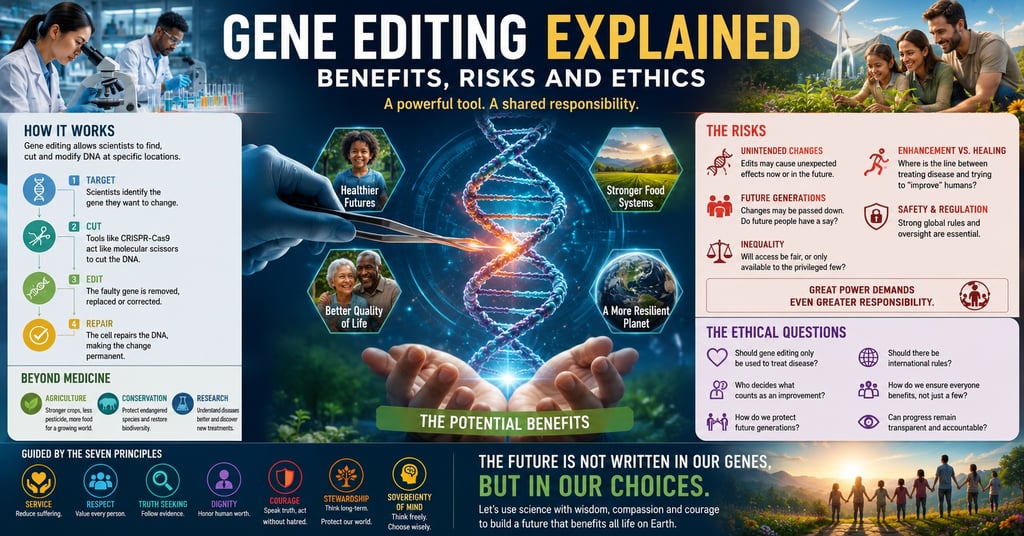
What Is Gene Editing?
Every living organism contains DNA, the genetic instructions that help determine how cells grow, function and reproduce.
Genes are individual sections of DNA that carry specific instructions.
Gene editing is the process of changing those instructions.
Scientists can remove, replace or modify specific genes with remarkable precision.
One of the best-known technologies is CRISPR-Cas9, often described as a pair of molecular scissors that can cut DNA at carefully chosen locations.
This allows researchers to repair certain genetic mutations or introduce carefully targeted changes.
Why Is Gene Editing Important?
Many serious illnesses result from faults in a single gene.
Scientists hope that correcting those faults could prevent or even cure diseases that have affected families for generations.
Research is exploring treatments for conditions including:
Sickle cell disease
Cystic fibrosis
Muscular dystrophy
Certain inherited blindness disorders
Some blood cancers
Although research is advancing rapidly, many applications are still being studied to ensure they are both safe and effective.
Beyond Human Medicine
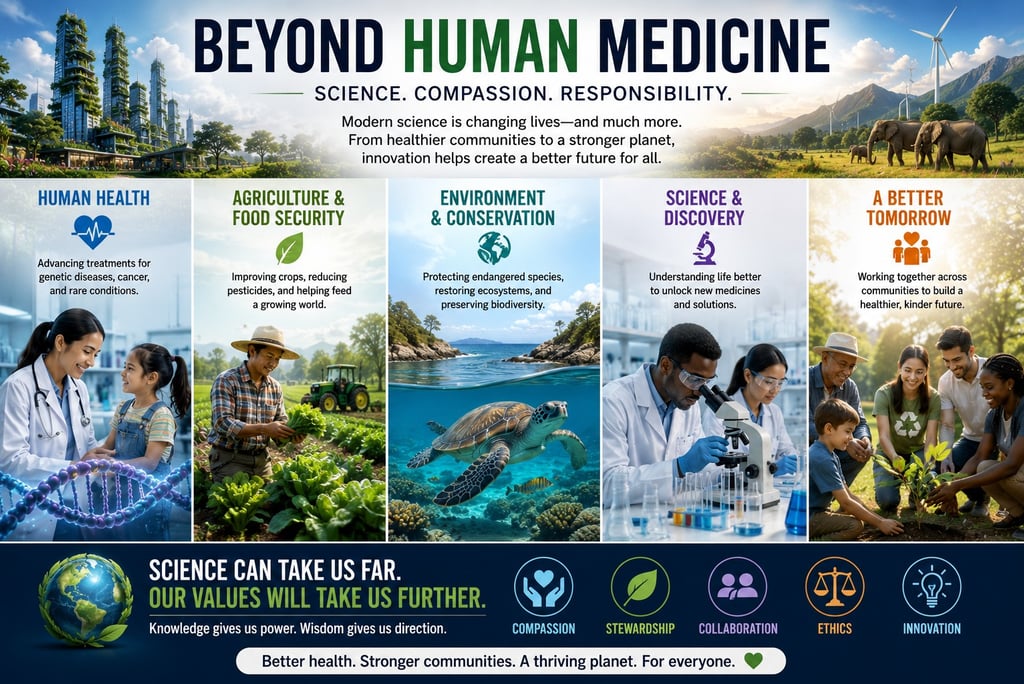
Gene editing could influence many areas of society.
Agriculture
Scientists are developing crops that are more resistant to drought, disease and pests.
This could improve food security while reducing the need for some pesticides.
Environmental Conservation
Researchers are exploring ways to help endangered species resist disease and improve ecosystem resilience.
Gene editing may also contribute to protecting biodiversity when used carefully and responsibly.
Scientific Research
Editing genes allows scientists to better understand diseases, accelerating the development of future medicines.
The Benefits
Reducing Human Suffering
Perhaps the greatest promise of gene editing is the possibility of preventing inherited diseases before they cause lifelong illness.
For many families, this represents hope that future generations may avoid conditions that have caused decades of suffering.
Improving Quality of Life
Rather than simply treating symptoms, gene editing aims to address the underlying genetic causes of some diseases.
This approach could transform healthcare over the coming decades.
Faster Medical Discoveries
Scientists can now investigate diseases more efficiently than ever before.
Better understanding often leads to better treatments.
Supporting Global Food Supplies
Climate change presents growing challenges for agriculture.
Gene-edited crops may help farmers produce more food while using fewer natural resources.
The Risks
Every powerful technology deserves careful oversight.
Gene editing is no exception.
Unintended Changes
Although modern techniques are becoming increasingly accurate, unintended changes to DNA remain an important area of scientific research.
Safety remains the highest priority.
Future Generations
Changes made to reproductive cells or embryos could potentially be passed to future generations.
Unlike ordinary medical treatments, these decisions may affect people who cannot give consent.
Inequality
If advanced genetic treatments remain expensive, access may be limited to wealthier individuals or countries.
This raises important questions about fairness and equal opportunity.
Enhancement Rather Than Treatment
Many people support using gene editing to prevent serious disease.
But should it be used to increase intelligence?
Height?
Athletic ability?
Appearance?
Where should society draw the line between healing and enhancement?
These questions continue to generate debate around the world.
The Ethical Questions
Gene editing challenges humanity to think carefully about responsibility.
Some of the most important questions include:
Should gene editing only be used to treat disease?
Who decides what counts as an improvement?
How do we protect future generations?
Should there be international rules?
How do we ensure everyone benefits rather than a privileged few?
Can scientific progress remain transparent and accountable?
These questions require thoughtful discussion, not simple answers.
What Does The Hidden Seven Think?
The Hidden Seven encourages scientific curiosity guided by ethical responsibility.
Knowledge has always been one of humanity's greatest strengths.
But wisdom determines how knowledge is used.
The Seven Principles offer a practical framework.
Service
Does this reduce suffering?
Respect
Does it benefit people fairly and equally?
Truth Seeking
Is it supported by reliable scientific evidence?
Dignity
Does it respect the value and autonomy of every human being?
Courage Without Hatred
Can we discuss difficult ethical issues openly and respectfully?
Stewardship
What long-term effects could today's decisions have on future generations?
Sovereignty of Mind
Are people making informed choices freely, without pressure or manipulation?
Technology should expand human wellbeing—not diminish our humanity.
A Future Written Carefully
Gene editing may become one of the defining technologies of this century.
It has the potential to cure disease, strengthen food security and improve lives across the world.
It also reminds us that scientific capability alone is not enough.
Every breakthrough brings responsibility.
Humanity must decide not only what science makes possible, but what wisdom considers right.
Final Thoughts
Gene editing is not simply a scientific achievement.
It is a test of human judgement.
If guided by compassion, evidence and responsibility, it could become one of medicine's greatest gifts.
If driven by profit, inequality or short-term thinking, it could deepen divisions and create new ethical challenges.
The future of gene editing will not be decided by technology alone.
It will be shaped by the values of the people who choose how to use it.
As science advances, perhaps our greatest responsibility is not changing our genes—but ensuring we never lose the qualities that make us human.
Connect
Join our journey toward wisdom and freedom
Subscribe
© 2026. All rights reserved.
The Seven Core Principles framework is intended for personal development and informational purposes and should not be considered legal, medical, financial, or psychological advice.
Use of this website is entirely at your own risk.
About Founder
Contact
Accessibility Statement