
The Seven Principles for Ethical Innovation | The Hidden Seven
Discover how the Seven Principles of The Hidden Seven provide an ethical framework for artificial intelligence, biotechnology, gene editing and future innovation.
AI AND TECHNOLOGY
Keeper of the Vision
7/24/20264 min read
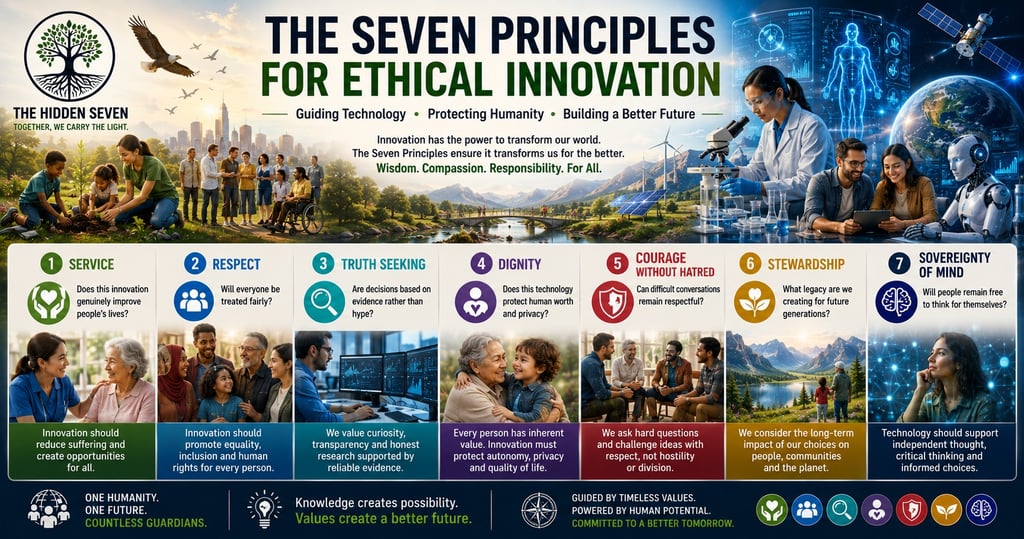
The Seven Principles for Ethical Innovation
Humanity has entered an extraordinary age.
Artificial intelligence can help discover new medicines.
Gene editing may one day prevent inherited diseases.
Brain-computer interfaces are restoring communication for people who have lost the ability to speak.
Scientists are exploring ways to extend healthy human life.
Innovations that once belonged to science fiction are becoming reality.
These breakthroughs offer tremendous opportunities.
They also raise profound ethical questions.
Just because we can build something, should we?
Who benefits?
Who decides?
How do we protect human dignity while embracing scientific progress?
These are not simply scientific questions.
They are human questions.
At The Hidden Seven, we believe the future should not be guided by technology alone.
It should be guided by timeless values.
That is why we believe the Seven Principles provide a practical ethical framework for innovation in the twenty-first century.
Innovation Is Neutral
Technology itself is neither good nor bad.
Fire can cook food.
Or destroy homes.
The internet can educate billions.
Or spread misinformation in seconds.
Artificial intelligence can diagnose disease earlier than ever before.
Or generate convincing scams and deepfakes.
Every powerful invention reflects the intentions of those who create and use it.
The challenge is not stopping innovation.
The challenge is ensuring innovation serves humanity.
Why Principles Matter
History shows that societies often develop new technologies faster than they develop the ethical frameworks needed to govern them.
Scientific progress moves quickly.
Human wisdom develops more slowly.
Without shared principles, powerful technologies may unintentionally increase inequality, reduce privacy, damage the environment or weaken trust.
The Seven Principles offer a way to ask better questions before adopting new technologies.
1. Service
Does this innovation genuinely improve people's lives?
Technology should reduce suffering.
Improve wellbeing.
Create opportunities.
Help communities flourish.
Innovation should never exist solely because it is profitable.
Its greatest purpose should always be service.
Examples include:
Medical breakthroughs that save lives.
Clean energy technologies.
Accessibility tools for disabled people.
Educational technologies that expand opportunity.
The first question should always be:
Who benefits?
2. Respect
Will everyone be treated fairly?
Scientific progress should benefit humanity as a whole.
Not only those who can afford it.
Respect means considering:
Equal access.
Cultural differences.
Human rights.
Individual freedoms.
Inclusion.
Technology should unite people.
Not divide them.
3. Truth Seeking
Are decisions based on evidence rather than hype?
Exciting headlines often promise revolutionary breakthroughs.
Responsible innovation requires careful scientific research.
Independent verification.
Transparency.
Open discussion.
Truth Seeking reminds us that extraordinary claims require strong evidence.
Curiosity should always outweigh certainty.
4. Dignity
Does this technology protect human worth?
Every person possesses inherent value.
Innovation should never reduce individuals to products, data points or commercial opportunities.
Dignity asks important questions.
Does it protect privacy?
Does it preserve autonomy?
Does it strengthen human relationships?
Does it improve quality of life rather than simply increasing efficiency?
Progress without dignity is not true progress.
5. Courage Without Hatred
Can difficult conversations remain respectful?
Emerging technologies often generate passionate disagreement.
Some people embrace every new invention.
Others fear every change.
Neither extreme serves society well.
Courage means asking difficult questions.
Without hostility.
Without misinformation.
Without attacking those who disagree.
Respectful discussion leads to wiser decisions.
6. Stewardship
What legacy are we creating?
Innovation affects future generations.
Today's choices shape tomorrow's world.
Stewardship encourages long-term thinking.
Will this technology protect the environment?
Will it strengthen communities?
Will future generations thank us for today's decisions?
Innovation should improve not only our lives—but the lives of those yet to be born.
7. Sovereignty of Mind
Will people remain free to think for themselves?
Perhaps no principle is becoming more important.
Artificial intelligence increasingly shapes what we see online.
Algorithms recommend news.
Social media influences opinion.
Digital systems affect purchasing decisions, entertainment and political discussion.
Sovereignty of Mind reminds us that technology should support independent thinking—not replace it.
People should remain capable of asking questions.
Evaluating evidence.
Changing their minds.
Making informed decisions.
Human judgement should never become obsolete.
Applying the Seven Principles
These principles can guide decisions in many fields.
Artificial Intelligence
Can AI improve healthcare while protecting privacy?
Gene Editing
Can disease be prevented while respecting human dignity?
Brain-Computer Interfaces
Can communication be restored without compromising freedom of thought?
Longevity Science
Can longer lives benefit everyone rather than a privileged few?
Robotics
Can automation improve productivity while supporting meaningful employment?
Environmental Innovation
Can new technologies restore ecosystems and reduce humanity's environmental impact?
The principles remain the same.
Only the technologies change.
Innovation Needs Character
Many discussions focus on smarter machines.
More powerful computers.
Faster algorithms.
But history teaches a different lesson.
The greatest advances have always depended upon human character.
Knowledge creates possibility.
Character determines direction.
Technology tells us what is possible.
Values help us decide what is right.
A Framework for the Future
The Hidden Seven does not oppose scientific progress.
We celebrate curiosity.
Research.
Discovery.
Innovation.
Human creativity has transformed the world for the better countless times.
But every generation must decide how knowledge will be used.
The Seven Principles offer a simple framework that can be applied by scientists, engineers, educators, businesses, governments and individuals alike.
Not because they provide every answer.
But because they encourage us to ask the right questions.
Final Thoughts
Humanity stands at one of the most remarkable moments in history.
Artificial intelligence, biotechnology, quantum computing and space exploration may reshape civilisation over the coming decades.
The future will not be determined by technology alone.
It will be determined by the values that guide its development.
If innovation is guided by service, respect, truth, dignity, courage, stewardship and freedom of thought, it has the potential to become one of humanity's greatest achievements.
Because the greatest invention humanity will ever create is not a machine.
It is a future where knowledge and wisdom grow together.
Connect
Join our journey toward wisdom and freedom
Subscribe
© 2026. All rights reserved.
The Seven Core Principles framework is intended for personal development and informational purposes and should not be considered legal, medical, financial, or psychological advice.
Use of this website is entirely at your own risk.
About Founder
Contact
Accessibility Statement