
Longevity Science: Can Humans Really Live Longer?
Discover what longevity science is, whether humans can live longer, and the breakthroughs, challenges and ethics shaping the future of healthy ageing.
AI AND TECHNOLOGY
Keeper of the Vision
7/24/20264 min read
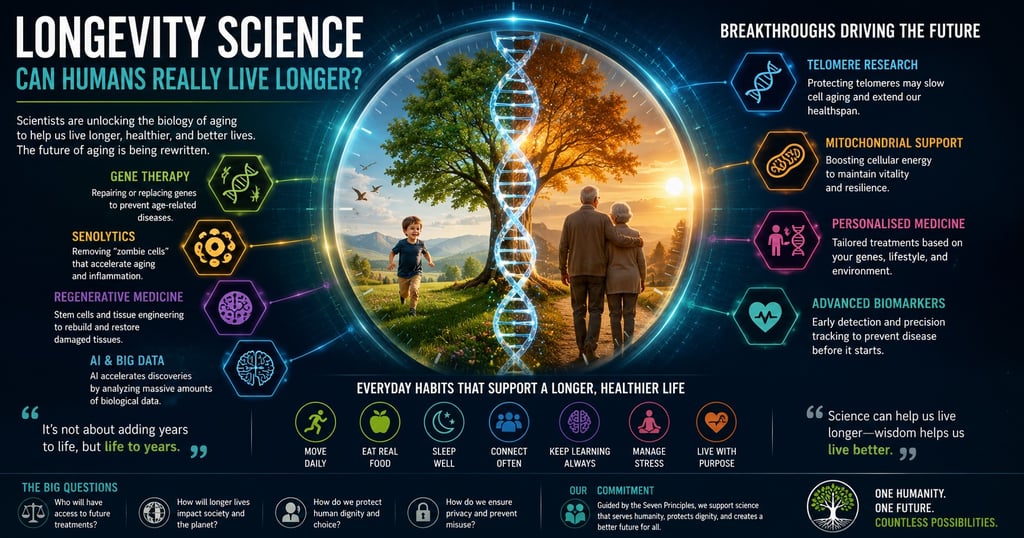
Longevity Science: Can Humans Really Live Longer?
For thousands of years, people have searched for the secret to a longer life.
Ancient legends spoke of magical springs and elixirs of youth.
Today, scientists are asking the same question—but with microscopes, genetics and artificial intelligence instead of myths.
The field is known as longevity science, and it has become one of the fastest-growing areas of medical research.
Its goal is not simply to help people live longer.
Its greater ambition is to help people stay healthier for longer.
But how close are we to achieving that goal?
And even if science succeeds, should we?
What Is Longevity Science?
Longevity science studies the biological processes that cause ageing and explores ways to slow, delay or even reverse aspects of those processes.
Instead of treating individual diseases one at a time, researchers hope to address some of the underlying causes of ageing itself.
If successful, this could reduce the risk of many age-related illnesses, including:
Heart disease
Alzheimer's disease
Parkinson's disease
Osteoporosis
Type 2 diabetes
Certain cancers
The aim is not immortality.
It is to increase healthspan—the number of years people remain healthy, active and independent.
Why Do We Age?
Scientists still do not fully understand ageing.
However, research has identified several biological processes that contribute to it.
These include:
DNA Damage
Every day, our cells experience damage from normal metabolism, sunlight, pollution and other environmental factors.
Although our bodies repair much of this damage, the repair process becomes less effective over time.
Cellular Senescence
Some cells stop dividing but refuse to die.
These "senescent cells" can accumulate with age and may contribute to inflammation and tissue decline.
Researchers are investigating therapies that selectively remove these cells.
Shortening Telomeres
Telomeres are protective caps on the ends of chromosomes.
They naturally become shorter each time a cell divides.
When they become too short, cells can no longer divide normally.
Mitochondrial Changes
Mitochondria are often called the power stations of cells.
As they become less efficient, cells may produce less energy and accumulate more damage.
Changes in Gene Regulation
Genes do not simply switch on or off.
Ageing appears to affect how genes are regulated, influencing repair, metabolism and immune function.
Understanding these changes is one of the major goals of longevity research.
The Technologies Driving Longevity Science
Modern research is advancing rapidly.
Some of the most promising areas include:
Artificial Intelligence
AI helps scientists analyse enormous amounts of biological data, identify potential drug candidates and accelerate medical discoveries.
Gene Therapy
Researchers are exploring ways to repair or replace faulty genes associated with disease and ageing.
Regenerative Medicine
Stem cells and tissue engineering may eventually help repair damaged organs and tissues.
Senolytic Medicines
Experimental drugs are being developed to remove harmful senescent cells while leaving healthy cells intact.
Personalised Medicine
Future healthcare may become increasingly tailored to each person's genes, lifestyle and environment.
Can Humans Really Live Longer?
The answer depends on what we mean by "longer."
Average life expectancy has increased dramatically over the past century due to:
Better sanitation
Vaccinations
Antibiotics
Improved nutrition
Safer working conditions
Advances in healthcare
Researchers now hope to extend not only lifespan but healthy lifespan.
Some scientists believe modest increases in healthy ageing are realistic over the coming decades.
Others believe much larger gains may eventually become possible.
No one knows for certain.
Many of the most ambitious predictions remain speculative and require far more research.
The Ethical Questions
Longevity science raises fascinating ethical questions.
Who Will Benefit?
If advanced treatments remain expensive, could longer healthy lives become available only to wealthy individuals?
Population Growth
If people live significantly longer, how might this affect housing, employment, healthcare and natural resources?
Fairness
Should extending life receive greater investment than preventing disease in developing countries?
Meaning
Would dramatically longer lives change how people view family, education, careers and purpose?
These questions remind us that science and ethics must develop together.
Everyday Habits That Already Support Healthy Ageing
While scientists continue searching for future breakthroughs, many of the strongest influences on healthy ageing are already well understood.
Research consistently supports habits such as:
Regular physical activity.
A balanced diet rich in fruit and vegetables.
Good-quality sleep.
Avoiding smoking.
Limiting excessive alcohol.
Maintaining social connections.
Lifelong learning and mental stimulation.
Managing stress.
There is no proven shortcut to a long, healthy life.
Daily choices remain remarkably important.
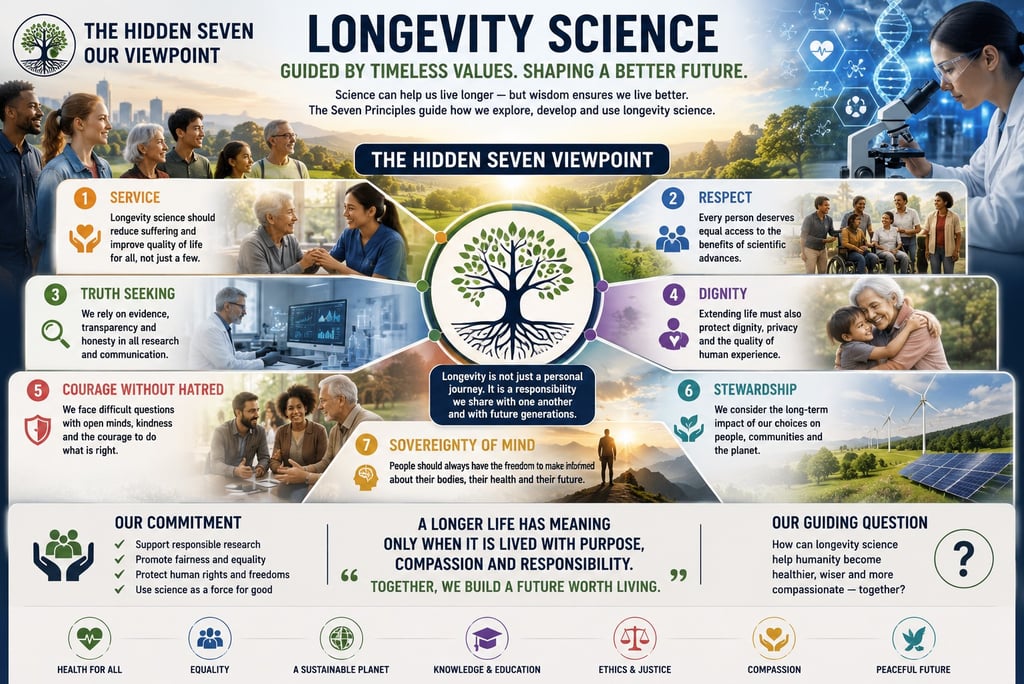
What Does The Hidden Seven Think?
The Hidden Seven welcomes scientific progress while recognising that wisdom must guide knowledge.
Living longer has little value if we neglect the qualities that give life meaning.
The Seven Principles offer a framework for responsible innovation.
Service
Does longevity science reduce suffering?
Respect
Will everyone have fair access to future treatments?
Truth Seeking
Are claims supported by reliable scientific evidence?
Dignity
Does extending life also protect quality of life?
Courage Without Hatred
Can difficult ethical questions be discussed openly and respectfully?
Stewardship
What responsibilities do longer lives create for future generations and the planet?
Sovereignty of Mind
People should always make informed choices about their healthcare and future.
Technology should expand freedom—not reduce it.
The Future of Healthy Ageing
Scientists are making remarkable progress.
Artificial intelligence is accelerating research.
Genetics is revealing new insights into ageing.
Medicine continues improving every year.
Yet perhaps the greatest lesson from longevity science is surprisingly simple.
Living longer is only part of the challenge.
Living well is the greater achievement.
Final Thoughts
Longevity science may one day transform medicine.
Future generations could enjoy healthier, longer and more active lives than ever before.
But no scientific breakthrough can replace kindness.
Or purpose.
Or relationships.
Or compassion.
Those remain the true foundations of a meaningful life.
Perhaps the greatest measure of a long life is not the number of years we experience.
It is how we choose to use the time we are given.
Because the legacy we leave behind will always matter more than the number of birthdays we celebrate.
Connect
Join our journey toward wisdom and freedom
Subscribe
© 2026. All rights reserved.
The Seven Core Principles framework is intended for personal development and informational purposes and should not be considered legal, medical, financial, or psychological advice.
Use of this website is entirely at your own risk.
About Founder
Contact
Accessibility Statement