
Can Technology Make Us More Human? Exploring AI, Innovation and Human Values
Can technology make us more human? Explore how AI, medicine and innovation can enhance our lives while preserving compassion, dignity and wisdom.
AI AND TECHNOLOGY
Keeper of the vision
7/24/20264 min read
Can Technology Make Us More Human?
For centuries, technology has transformed the way we live.
The wheel allowed us to travel farther.
Printing presses spread knowledge.
Vaccines saved millions of lives.
The internet connected billions of people across the world.
Today, artificial intelligence, biotechnology, robotics and brain-computer interfaces are opening possibilities our ancestors could scarcely imagine.
But they also raise an unexpected question.
Can technology actually make us more human?
At first, the answer seems obvious.
Technology is made of metal, silicon and code.
Humanity is built on compassion, creativity, relationships and purpose.
Yet history tells a more interesting story.
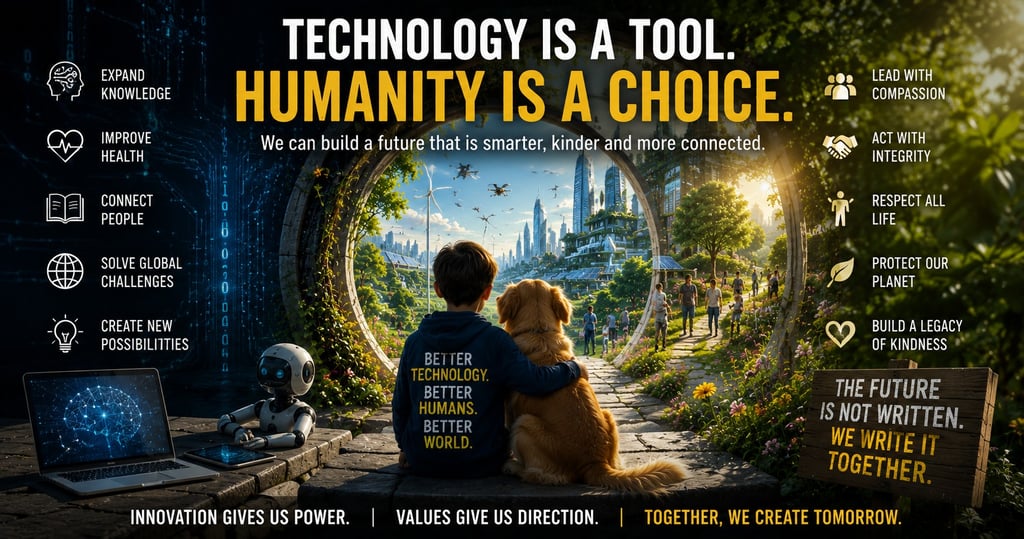
Perhaps technology has never been about replacing humanity.
Perhaps its greatest purpose has always been helping humanity express its best qualities.
What Does It Mean to Be Human?
Before answering whether technology can make us more human, we should ask a simpler question.
What makes us human in the first place?
Is it intelligence?
Computers now solve mathematical problems faster than any person.
Is it memory?
A smartphone remembers more information than any human brain.
Is it strength?
Machines have surpassed human physical power for centuries.
Perhaps humanity has never been defined by what we can do.
Perhaps it is defined by why we do it.
Our capacity for empathy.
Curiosity.
Forgiveness.
Creativity.
Love.
Moral responsibility.
The ability to choose kindness even when it is difficult.
These are qualities no machine truly possesses.
Technology Has Always Extended Human Potential
Every major invention has expanded what people can achieve.
Eyeglasses restored sight.
Hearing aids reconnected people with loved ones.
Wheelchairs created independence.
Pacemakers saved lives.
Artificial limbs restored movement.
Few people would argue these technologies made humanity less human.
Instead, they allowed people to participate more fully in life.
Modern technologies may simply continue that journey.
Artificial Intelligence as a Tool
Artificial Intelligence is often described as replacing people.
In reality, many of its greatest successes involve supporting them.
Doctors use AI to identify diseases earlier.
Scientists analyse enormous datasets in minutes.
Teachers create personalised learning resources.
Engineers design safer buildings.
Conservationists monitor endangered wildlife.
Writers and artists use AI to explore new creative ideas.
The technology itself has no purpose.
Its value depends entirely on the intentions of those using it.
Where Technology Cannot Replace Humanity
No algorithm can truly comfort a grieving friend.
No robot understands what it means to love a child.
No machine experiences hope.
Or courage.
Or forgiveness.
Artificial intelligence can imitate conversation remarkably well.
But genuine compassion comes from lived human experience.
Technology can assist these moments.
It cannot replace them.
That distinction matters.
The Danger of Forgetting What Matters
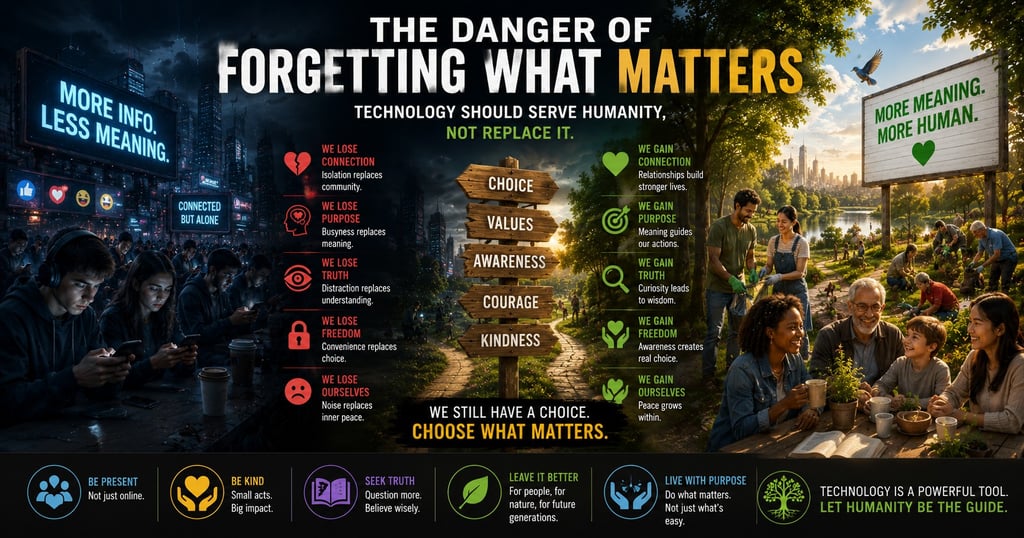
Technology becomes dangerous when efficiency replaces wisdom.
When convenience replaces relationships.
When profit replaces dignity.
When algorithms determine truth.
When human judgement is surrendered without question.
History reminds us that every powerful invention can be used for good or harm.
The challenge has never been technology itself.
The challenge has always been human choices.
Could Technology Increase Compassion?
Surprisingly, it might.
Translation software allows people from different cultures to communicate.
Accessibility technologies help people participate more fully in society.
Medical breakthroughs reduce suffering.
Artificial intelligence helps identify humanitarian crises more quickly.
Environmental monitoring helps protect endangered species.
When technology removes barriers between people, it has the potential to strengthen our shared humanity.
Not weaken it.
The Hidden Seven Perspective
The Hidden Seven believes technology should never become humanity's master.
It should remain humanity's servant.
Every innovation should be measured by timeless questions.
Does it reduce suffering?
Does it respect human dignity?
Does it encourage truth?
Does it strengthen communities?
Does it preserve freedom of thought?
Does it protect future generations?
Does it help people become more compassionate?
If the answer is yes, technology can become one of humanity's greatest achievements.
If the answer is no, even the most advanced invention may ultimately diminish us.
Humanity's Greatest Upgrade
Many people talk about upgrading human intelligence.
Or extending lifespan.
Or merging minds with computers.
These are fascinating possibilities.
But perhaps humanity's greatest upgrade has nothing to do with silicon chips.
Imagine a civilisation where people became:
More honest.
More compassionate.
More courageous.
More respectful.
More curious.
More responsible.
More willing to help strangers.
Those improvements require no software update.
Only individual choices.
Technology may help us achieve extraordinary things.
Character determines whether those achievements improve the world.
Looking Ahead
Artificial intelligence and biotechnology will continue to reshape society throughout this century.
New discoveries will challenge old assumptions.
Some developments will inspire hope.
Others will raise legitimate concerns.
But one truth remains constant.
Technology changes what is possible.
Human values determine what is desirable.
That is why ethics, wisdom and compassion are becoming more important—not less—as technology advances.
Final Thoughts
Technology cannot teach kindness.
It cannot choose courage.
It cannot experience love.
Those remain uniquely human gifts.
But technology can remove barriers that prevent us from expressing those qualities.
Perhaps the future is not about becoming less human.
Perhaps it is about using our greatest inventions to become the very best versions of ourselves.
Because in the end, the question is not whether machines will become more like people.
The real question is whether people will use technology to become wiser, kinder and more compassionate than ever before.
Connect
Join our journey toward wisdom and freedom
Subscribe
© 2026. All rights reserved.
The Seven Core Principles framework is intended for personal development and informational purposes and should not be considered legal, medical, financial, or psychological advice.
Use of this website is entirely at your own risk.
About Founder
Contact
Accessibility Statement