
Transhumanism: The Future of Humanity?
Explore transhumanism, AI, gene editing, and human enhancement. Discover the opportunities, risks, and ethical questions shaping humanity's future.....
AI AND TECHNOLOGY
Keeper of the Vision
7/24/20263 min read
Transhumanism: The Future of Humanity or the Beginning of Something New?
Imagine a future where blindness can be reversed, paralysis overcome, Alzheimer's disease prevented, and damaged organs replaced before they fail.
Much of this is no longer science fiction.
It is the vision of transhumanism—a movement that explores how science and technology can improve human health, intelligence, and quality of life.
Supporters believe technology can help humanity overcome many of its greatest limitations.
Critics ask an equally important question:
Just because we can, should we?
As artificial intelligence, biotechnology, robotics, gene editing, and brain-computer interfaces continue to advance, this debate is becoming one of the defining conversations of the twenty-first century.
What Is Transhumanism?
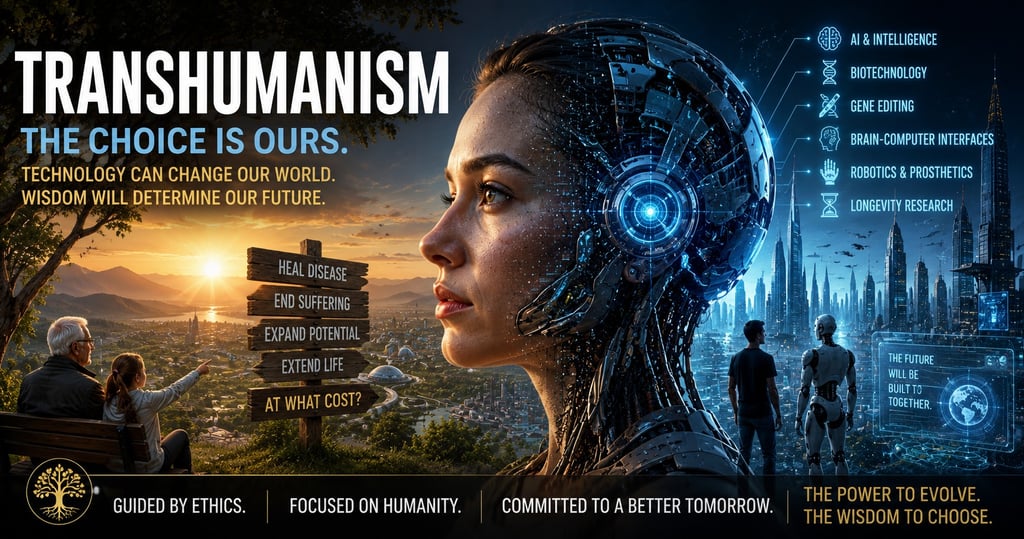
Transhumanism is the belief that humanity can responsibly use technology to enhance physical and mental abilities, reduce suffering, and extend healthy life.
It is not a single organisation or religion.
Instead, it is a broad philosophical movement that includes scientists, engineers, ethicists, doctors, entrepreneurs, and futurists.
Some of its goals include:
Treating or eliminating genetic diseases.
Restoring lost sight and hearing.
Creating advanced prosthetic limbs.
Developing brain-computer interfaces.
Slowing or reversing aspects of ageing.
Using artificial intelligence to accelerate medical discoveries.
For many people, these goals are already becoming reality.
Technologies Changing the Future
Several rapidly developing technologies are driving interest in transhumanism.
Artificial Intelligence
AI is helping researchers discover new medicines, diagnose diseases more accurately, and analyse enormous amounts of scientific data in seconds.
Gene Editing
Technologies such as CRISPR allow scientists to modify DNA with unprecedented precision, offering hope for inherited diseases that were once considered untreatable.
Brain-Computer Interfaces
Researchers are developing systems that allow computers to communicate directly with the brain, potentially helping people recover communication or movement after severe injuries.
Advanced Prosthetics
Modern prosthetic limbs increasingly provide natural movement, sensation, and greater independence for users.
Longevity Research
Scientists are investigating ways to slow the biological processes associated with ageing, helping people remain healthier for longer.
Why Are People Excited?
Many supporters see transhumanism as the next stage of human progress.
Throughout history, humanity has improved life through innovation.
Vaccinations reduced deadly diseases.
Antibiotics transformed medicine.
Eyeglasses restored vision.
Pacemakers save lives.
Artificial joints restore mobility.
Each innovation once seemed extraordinary.
Many believe today's emerging technologies simply continue that tradition.
The Ethical Questions
Every major technological breakthrough brings new responsibilities.
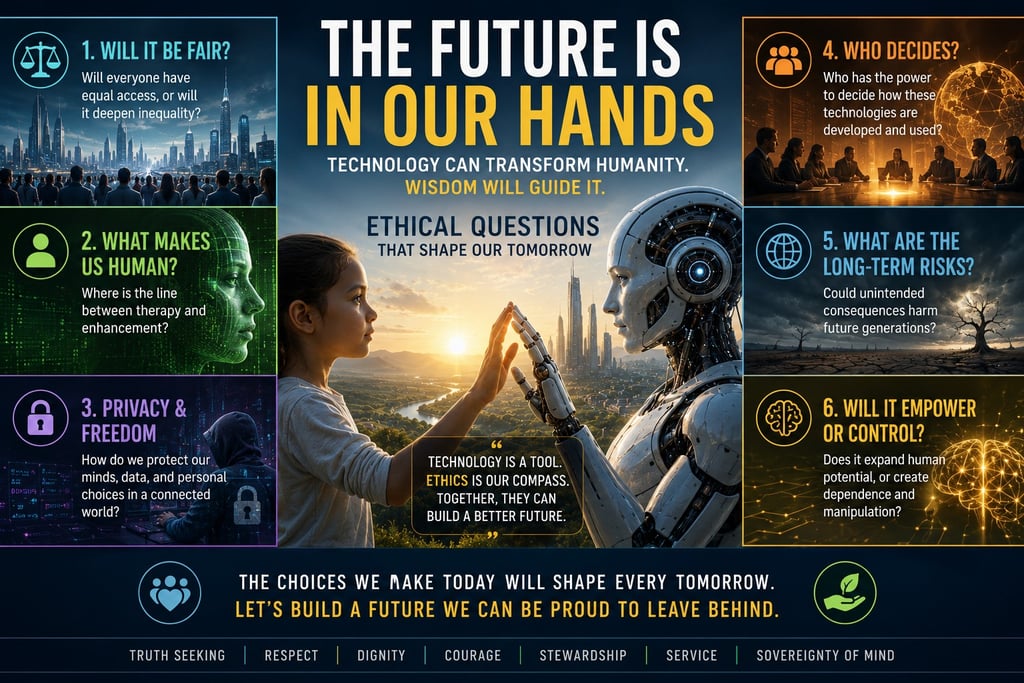
Some of the biggest questions include:
Will Everyone Benefit?
If powerful enhancements become expensive, could they widen inequality between rich and poor?
What Makes Us Human?
If memories, intelligence, or physical abilities can be enhanced, where do we draw the line between treatment and enhancement?
Privacy and Freedom
As technology becomes more integrated with our lives, how do we protect personal privacy and individual autonomy?
Artificial Intelligence
As AI becomes increasingly capable, how should it be governed to ensure it benefits humanity rather than causing unintended harm?
These are not easy questions—and they deserve thoughtful discussion.
A Balanced Perspective
It is easy to see transhumanism as either a miracle or a threat.
Reality is more complex.
Technology itself is neither good nor bad.
Its impact depends on how people choose to develop and use it.
History shows that knowledge can heal—or harm.
The same discovery that creates life-saving medicine can also be misused.
Progress therefore requires not only scientific excellence but also wisdom, compassion, and accountability.
What Does The Hidden Seven Think?
The Hidden Seven encourages curiosity, evidence-based thinking, and ethical responsibility.
Rather than accepting or rejecting new technologies automatically, the Seven Principles provide a framework for asking better questions.
Service: Does this technology genuinely reduce suffering?
Respect: Will everyone have fair opportunities to benefit?
Truth Seeking: What does the best available evidence show?
Dignity: Does it respect the value and autonomy of every person?
Courage Without Hatred: Can we discuss difficult issues respectfully?
Stewardship: What are the long-term consequences for humanity and the planet?
Sovereignty of Mind: Does this technology increase human freedom, or reduce it?
These principles encourage responsible innovation rather than blind optimism or fear.
The Future Is Being Written Today
Whether or not someone identifies as a transhumanist, the technologies shaping this movement are already influencing modern life.
Artificial intelligence is transforming research.
Medical breakthroughs continue to expand what is possible.
Genetic medicine is advancing rapidly.
The decisions society makes over the coming decades will shape future generations.
The challenge is not simply to build more powerful technology.
The greater challenge is ensuring that human wisdom grows alongside it.
Because the future of humanity will not be determined by technology alone.
It will be determined by the values that guide the people who create and use it.
Final Thoughts
Transhumanism asks one of the biggest questions humanity has ever faced:
How should we use our growing knowledge?
There may never be one universal answer.
But there is enormous value in asking the question carefully, honestly, and with compassion.
As technology continues to advance, perhaps our greatest responsibility is not simply becoming more powerful—but becoming wiser.
Only then can progress truly serve humanity.
Connect
Join our journey toward wisdom and freedom
Subscribe
© 2026. All rights reserved.
The Seven Core Principles framework is intended for personal development and informational purposes and should not be considered legal, medical, financial, or psychological advice.
Use of this website is entirely at your own risk.
About Founder
Contact
Accessibility Statement